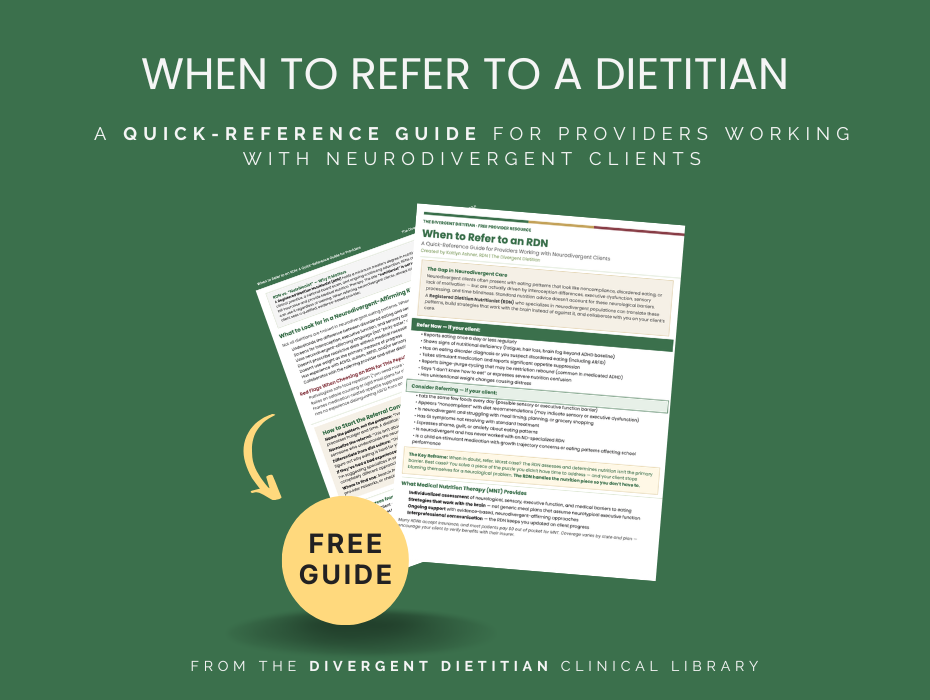

Your referral said “needs nutrition support.” That’s it.
The dietitian opened the first session with a standard intake. Asked about meals. Mentioned meal planning. Suggested tracking food for a week. Your client — who has significant sensory aversions, takes 30mg Vyvanse XR at 7am, hasn’t had a positive experience with a dietitian in their life, and describes their eating as “I forget to eat and then I eat everything at night” — shut down in the first 15 minutes. They didn’t schedule a follow-up.
The dietitian wasn’t bad. The referral was incomplete. And the information that would have changed the entire first session — the medication timing, the sensory profile, the emotional context, the client’s own language for the problem — takes about 2 minutes to include. Nobody includes it because nobody has a format for it.
This is that format.
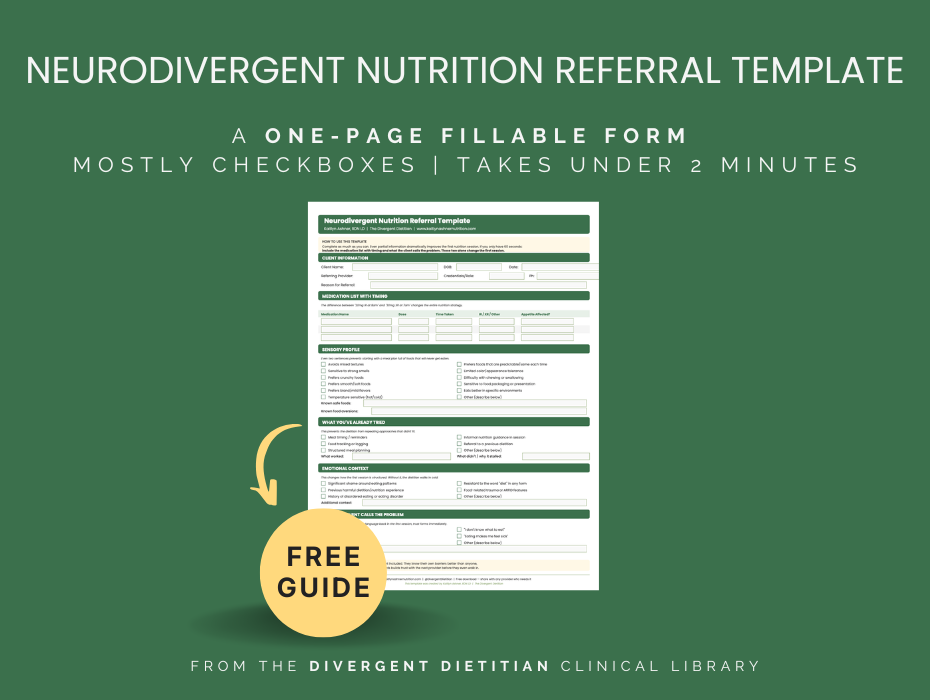
One page. Mostly checkboxes. Five sections that give a neurodivergent nutrition specialist everything they need to walk into the first session prepared — instead of spending three sessions gathering information that could have been in the referral.
WHAT HAPPENS WHEN YOU USE THIS TOOL
You’re writing a referral for nutrition support. Instead of a free-text note that says “client struggling with eating,” you open this template. You check boxes. Client avoids mixed textures — check. Sensitive to strong smells — check. Takes Adderall 20mg IR at 8am, appetite significantly affected — filled in. Previous harmful dietitian experience — check. Client describes the problem as “I forget to eat” — check.
You add one line in the client’s own words: “I know I need to eat but by the time I think about it, it’s 4pm and I just can’t.”
You attach the template to the referral and send.
The dietitian opens it before the first session. They already know not to start with a meal plan full of soups and casseroles. They know to mirror “I forget to eat” back instead of using clinical language. They know the client has shame around their eating patterns and that the word “diet” is a nonstarter. They know the medication window and can build the nutrition strategy around it.
The first session starts where session three usually starts. Your client feels understood. The dietitian feels prepared. Three wasted sessions become one productive one.
The whole thing takes 2 minutes on your end. If you only have 60 seconds: include the medication list with timing and what the client calls the problem. Those two alone change the first session.
WHY I BUILT THIS
I built this because I kept receiving referrals that said “needs nutrition support” and nothing else. Then I’d spend the first two or three sessions discovering that my client takes stimulant medication that kills their appetite by 9am, has significant sensory aversions I’d never have guessed, has been harmed by a previous dietitian, and describes their problem in language completely different from what I’d been using.
Every piece of that information changes my approach. The medication timing changes the entire meal structure. The sensory profile tells me which foods are actually on the table. The emotional context tells me how to structure the session so my client doesn’t shut down. And when I mirror their own language back — “you mentioned you forget to eat” instead of “let’s talk about your meal pattern” — I can watch the trust form in real time.
None of this is hard to include. It just wasn’t being asked for, because there wasn’t a format that made it easy.
This template is that format. It’s mostly checkboxes because I know you’re writing referrals between sessions with 4 minutes to spare. It includes the five things that change a first nutrition session from generic to genuinely useful — and it takes less time to complete than the free-text note you were going to write anyway.
From the template: “Ask the client what they want included. They know their own barriers better than anyone, and a referral that contains their own words builds trust with the next provider before they even walk in.”
WHAT’S INSIDE (1 PAGE)
Client Information — Name, DOB, referring provider, credentials, phone, reason for referral. The basics, formatted so nothing gets lost.
Medication List with Timing — A table with columns for medication name, dose, time taken, IR/XR/other, and whether appetite is affected. Because the difference between “20mg IR at 8am” and “30mg XR at 7am” changes the entire nutrition strategy. Three rows — enough for most medication regimens, space-efficient for the ones that aren’t complex.
Sensory Profile — 12 pre-populated checkboxes covering the most common sensory eating patterns: avoids mixed textures, sensitive to strong smells, prefers crunchy foods, prefers bland/mild flavors, temperature sensitive, prefers predictable foods, and more. Plus open fields for known safe foods and known food aversions. Even two sentences here prevents the dietitian from starting with a meal plan full of foods that will never get eaten.
What You’ve Already Tried — 6 checkboxes: meal timing/reminders, food tracking, structured meal planning, informal nutrition guidance in session, referral to a previous dietitian, and other. Plus fields for what worked and what didn’t. This prevents the dietitian from repeating approaches that didn’t fit.
Emotional Context — 6 checkboxes: significant shame around eating patterns, previous harmful dietitian/nutrition experience, history of disordered eating or eating disorder, resistant to the word “diet” in any form, food-related trauma or ARFID features, and other. Plus an open field for additional context. This changes how the first session is structured. Without it, the dietitian walks in cold.
What the Client Calls the Problem — 6 common phrases pre-loaded as checkboxes: “I forget to eat,” “I can’t stop eating at night,” “I only eat one food,” “I don’t know what to eat,” “Eating makes me feel sick,” and other. Plus a field for the client’s own words. When the dietitian mirrors that language back in the first session, trust forms immediately.

WHO THIS IS FOR
- Therapists and psychologists who refer neurodivergent clients for nutrition support and want to send more than “needs nutrition help” — this gives the dietitian everything they need to start strong
- Psychiatrists and prescribers managing stimulant medication who want the dietitian to know the exact medication, dose, and timing — so the nutrition strategy is built around the medication window, not against it
- OTs and SLPs who work with sensory processing and feeding and want to communicate the sensory profile to a dietitian in a format that translates directly to meal planning
- PCPs and nurse practitioners who make nutrition referrals and have 60 seconds between patients — the medication table and “what the client calls the problem” checkboxes take under a minute and change the entire first session
- Any provider who has ever sent a referral and suspected the nutrition piece didn’t go anywhere — this is often why
WHAT MAKES THIS ONE DIFFERENT
Most referral forms ask for diagnosis, insurance, and reason for referral. This one asks for the five things that actually determine whether the first nutrition session works: medication timing, sensory profile, what’s already been tried, emotional context, and the client’s own language for the problem.
It’s fillable — open it in any PDF reader, click the checkboxes, type in the fields, save, and attach. It’s also print-friendly for providers who prefer paper. The sensory profile and emotional context sections use pre-populated checkboxes because you don’t have time to write paragraphs between sessions — but every section includes an open field for the details that checkboxes can’t capture.
This template was designed by a neurodivergent-affirming RDN who receives these referrals. Every checkbox, every field, every pre-loaded phrase exists because its absence has cost a client three wasted sessions.
YOU MAY ALSO LIKE
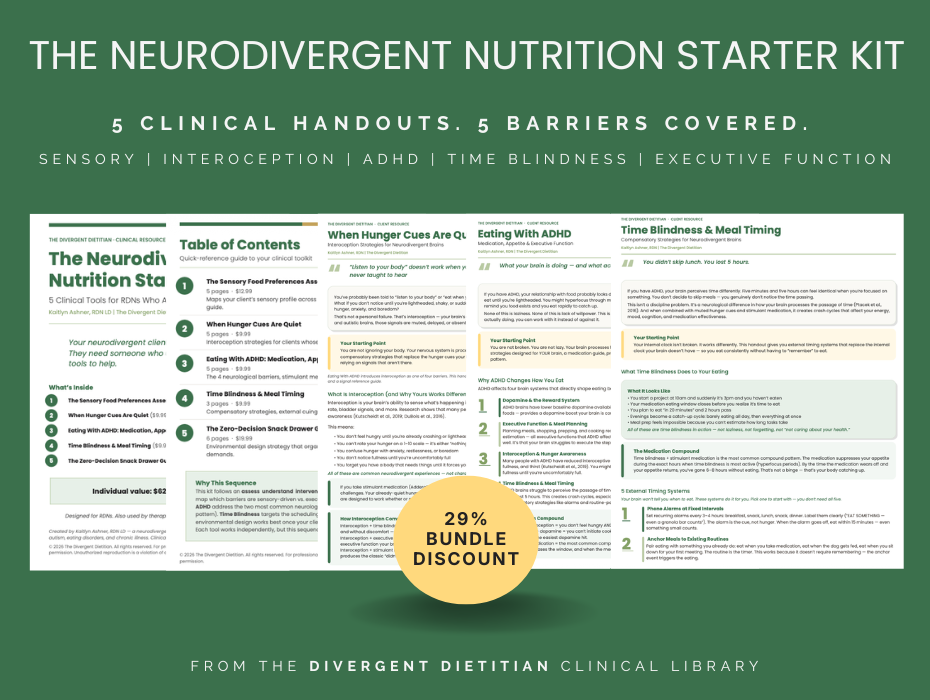
- When Hunger Cues Are Quiet: Interoception Strategies — $9.99
- Time Blindness & Meal Timing: Building External Systems — $9.99
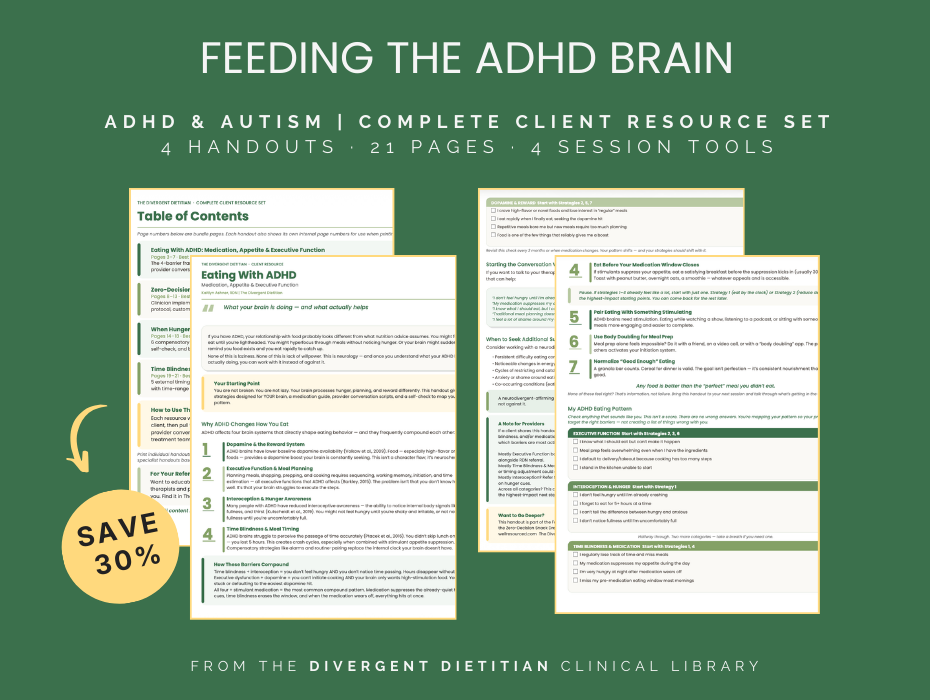
- Feeding the ADHD Brain: Complete Client Resource Set (Bundle) — $34.99
PRICE: FREE
FORMAT: PDF, 1 page, US Letter, fillable form fields, print-ready, instant download
CREATED BY: Kaitlyn Ashner, RDN LD — neurodivergent-affirming nutrition specialist, AuDHD clinician, and creator of The Divergent Dietitian
You must log in and be a buyer of this download to submit a review.