
You built a neurodivergent nutrition handout from scratch last week. It took you 3 hours. Your client used it once.
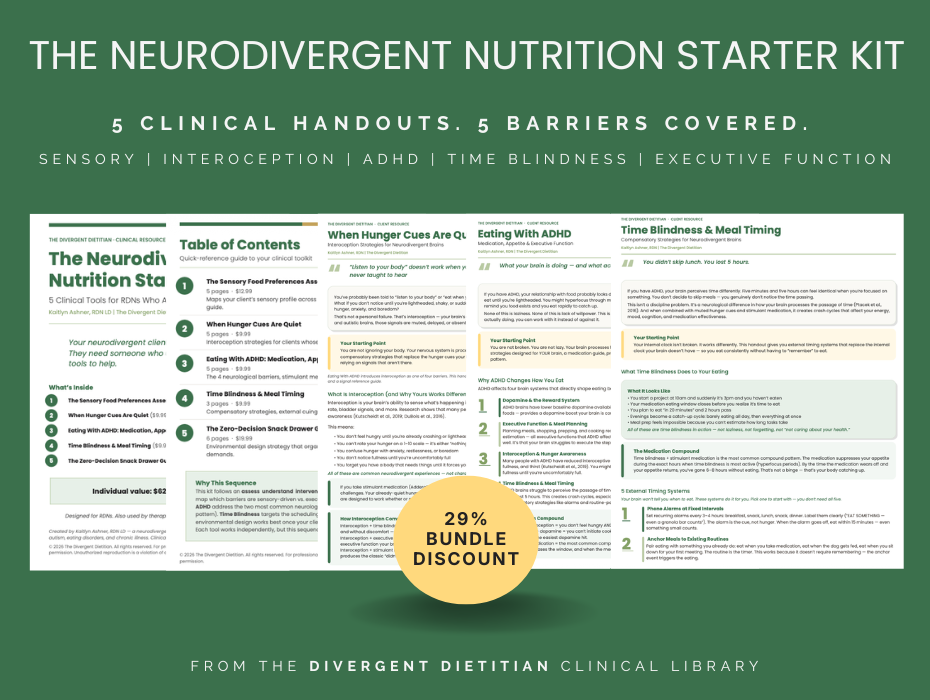
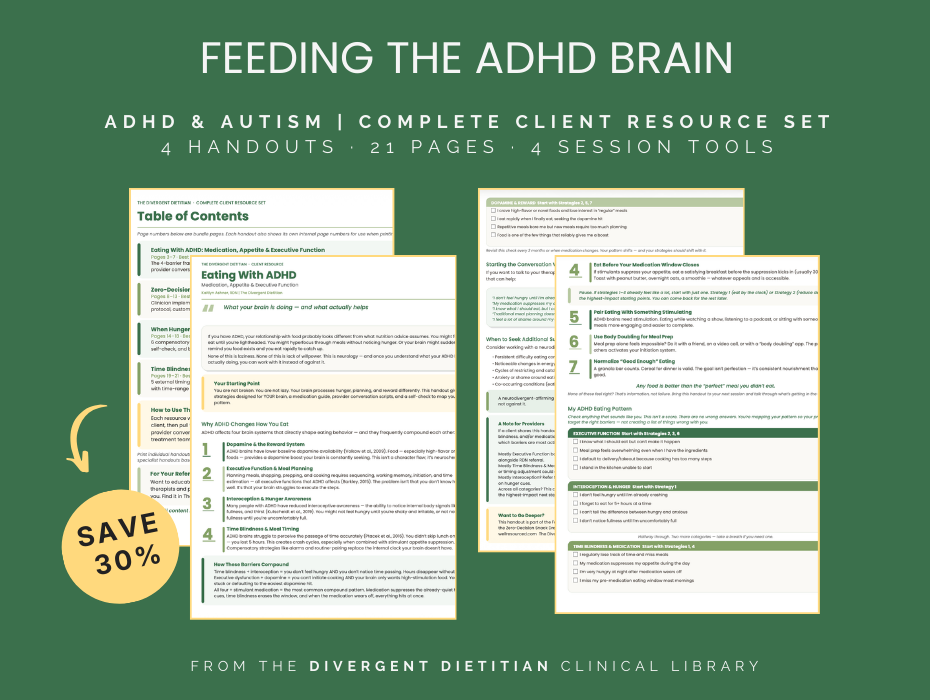
Now imagine having 4 clinical handouts — 21 pages of evidence-informed, session-ready tools — covering every major ADHD and autism eating barrier, already designed, already cited, already HAES-screened, ready to print and use tomorrow morning. That’s what this bundle is.

$34.99. Four handouts. Four interactive session tools. The toolkit you’d build yourself if you had 12 spare hours and a design degree. You don’t need either — you just need this.
$9.99 + $19.99 + $9.99 + $9.99 = $49.96 individually → $34.99 bundled. Save 30%.
WHAT’S INSIDE (AND WHEN TO USE EACH ONE)
This isn’t a stack of 21 pages you hand to every client. It’s a modular system. Start with the overview, then pull the specialist tool based on which barrier your client’s self-check identifies as most active.

Eating With ADHD: Medication, Appetite & Executive Function (Pages 3–7) Best for: every ADHD client — start here
The foundation handout. Introduces the 4-barrier framework (dopamine, executive function, interoception, time blindness), explains how they compound, provides a stimulant medication guide, and gives your client 7 strategies designed for ADHD brains — not adapted from neurotypical advice, designed from the ground up. The interactive self-check maps their unique barrier pattern directly to numbered strategies, so you both know exactly where to focus. Provider conversation scripts let your client advocate for themselves in appointments with other members of their treatment team.
Interactive tool: My ADHD Eating Pattern Self-Check — 4 barrier categories with strategy mapping
Zero-Decision Snack Drawer: ADHD & Autism Clinical Session Tool (Pages 8–13) Best for: clients struggling with meal prep, snacking, and food decision fatigue
The only dual-format product in the bundle — pages 8–9 are YOUR clinician implementation guide with a session protocol, 5 population adaptations (ADHD inattentive, autistic, ARFID, co-occurring anxiety, AuDHD), a stimulant medication timing protocol, and interdisciplinary talking points for therapists, prescribers, and OTs. Pages 10–13 are the CLIENT handout: 4 sensory-organized snack categories with 28 grab-ready options, a custom combo builder, and a weekly shopping list organized by sensory category. This is the product that replaces the pantry paralysis conversation you have with every executive-dysfunction client.
Interactive tools: Sensory Category Checkbox Grids + My Custom Combos Builder + Weekly Shopping List
When Hunger Cues Are Quiet: Interoception Strategies (Pages 14–18) Best for: clients who don’t feel hunger
The deep-dive for clients whose primary barrier is muted or absent hunger signals — the ones for whom “listen to your body” has never worked because their body whispers in a language they were never taught to hear. 6 compensatory strategies that bypass hunger cues entirely: alarm-based eating, transition-anchored meals, external body check-ins, environmental food cues, pattern tracking, and “good enough” eating. The Eating Cue System worksheet lets you co-create a personalized external interoception system in session — alarm times, transition anchors, check-in schedule, grab-ready food list. Your client walks out with a concrete plan, not a list of tips. The “Loud Signals” table translates the physical symptoms they DO notice (lightheaded, irritable, foggy, shaky, headache) into eating actions.
Interactive tools: My Eating Cue System Worksheet + My Interoception Pattern Self-Check + Your Body’s “Loud Signals” Table
Time Blindness & Meal Timing: Compensatory Strategies (Pages 19–21) Best for: clients who lose track of time and skip meals
The deep-dive for clients whose brain doesn’t track the passage of time — the ones who start a project at 10am and surface at 3pm without eating. 5 external timing systems including the Pre-Medication Breakfast Protocol (“eat first, medicate second”) and the End of Hyperfocus Snack — two strategies you won’t find in any other resource because they name the specific ADHD moments where eating matters most and is least likely to happen. The weekly tracker with time-range column headers is designed for brains that genuinely don’t know whether 11:30am is “morning” or “midday.”
Interactive tool: My Weekly Meal Timing Tracker (7-day grid with time ranges — reuse weekly)
HOW TO USE THIS BUNDLE IN YOUR PRACTICE
Session 1 with a new ADHD client: Start with Eating With ADHD (pages 3–7). Walk through the 4-barrier framework. Have your client complete the self-check. You now know their primary barrier pattern.
Follow-up sessions: Pull the specialist handout based on the self-check results. Mostly interoception? Use When Hunger Cues Are Quiet and co-create the Eating Cue System. Mostly time blindness? Use the Time Blindness tracker and build their external timing system. Struggling with snacking and meal prep? Walk through the Zero-Decision Snack Drawer together.
Between sessions: Your client takes home whichever handout you used, plus the overview. They have provider conversation scripts to share with their therapist or prescriber. They have interactive tools to fill in and bring back to the next appointment. The trackers and self-checks are designed for repeat use — revisit every 3 months or when medication changes.
That’s a complete clinical workflow for neurodivergent nutrition: assess the barrier pattern → pull the right tool → co-create the personalized system → track between sessions → reassess. In a toolkit that costs less than one hour of your billable time.
WHO THIS IS FOR
- RDNs building or expanding a neurodivergent-affirming nutrition practice who want a complete clinical toolkit instead of building resources from scratch — this bundle replaces 8–12 hours of handout creation
- RDNs who already own one or two of these handouts individually and want the complete set at a 30% discount — everything you’d eventually buy, at the best price available now
- RDNs who see ADHD and autistic clients regularly and want a structured, barrier-based assessment-to-intervention framework with session-ready tools for every major eating barrier
- Clinical supervisors and practice owners who want a standard toolkit for all clinicians on their team working with neurodivergent populations
WHAT MAKES THIS BUNDLE DIFFERENT
Most ADHD nutrition resources are individual handouts with generic tips. This is an integrated clinical system where each product connects to the others. The overview identifies the barrier. The specialist tools address it. The self-checks and trackers measure progress. The provider scripts extend the work to the full treatment team. And every resource shares the same clinical framework, design system, and evidence base — so your client experiences consistency across every handout you share with them.
All 4 handouts include provider conversation scripts and a “Note for Providers” section — share these with the therapists, prescribers, and OTs on your client’s treatment team so everyone speaks the same barrier-first language.
From the bundle: “Any food is better than the perfect meal you didn’t eat.”
All content is HAES-aligned and weight-neutral. No diet culture. No food rules. No calorie counts. No shame.
WANT TO EDUCATE YOUR REFERRAL PARTNERS?
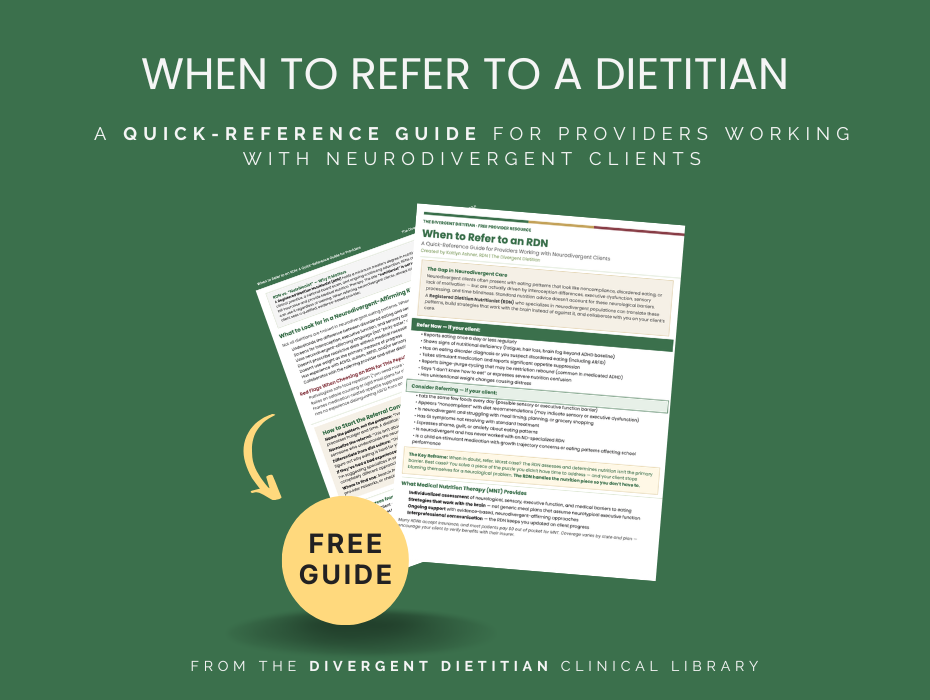
The Not Laziness Provider Education Tool ($14.99) teaches therapists and prescribers to recognize these same 4 barriers, screen for them in 60 seconds, and make warm referrals to you. The free version — Not Laziness: The 4 Nutrition Barriers — introduces the framework. Find both in The Divergent Dietitian shop.
ALSO FROM THE DIVERGENT DIETITIAN
- Sensory Food Preferences Assessment Tool — $14.99
- Not Laziness: Provider Education Tool — $14.99
- Not Laziness: The 4 Nutrition Barriers — FREE
PRICE: $34.99 (save 30% vs. purchasing individually)
FORMAT: PDF, 21 pages, US Letter, print-ready, instant download, professionally designed with neurodivergent-accessible formatting
CREATED BY: Kaitlyn Ashner, RDN — neurodivergent-affirming nutrition specialist, AuDHD clinician, and creator of The Divergent Dietitian
You must log in and be a buyer of this download to submit a review.