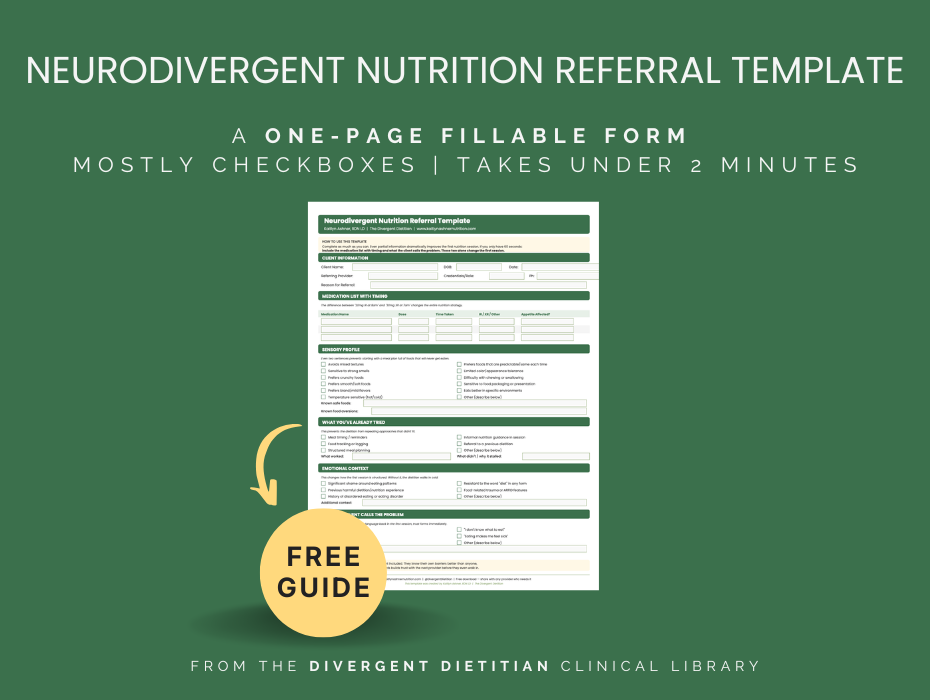

You know your neurodivergent client is struggling with food. You can see it — the weight changes, the “I just don’t eat,” the same three foods at every appointment. But you weren’t trained to know whether that’s an eating disorder, sensory processing, executive dysfunction, or something else entirely. And you don’t have time to figure it out in a 15-minute visit.
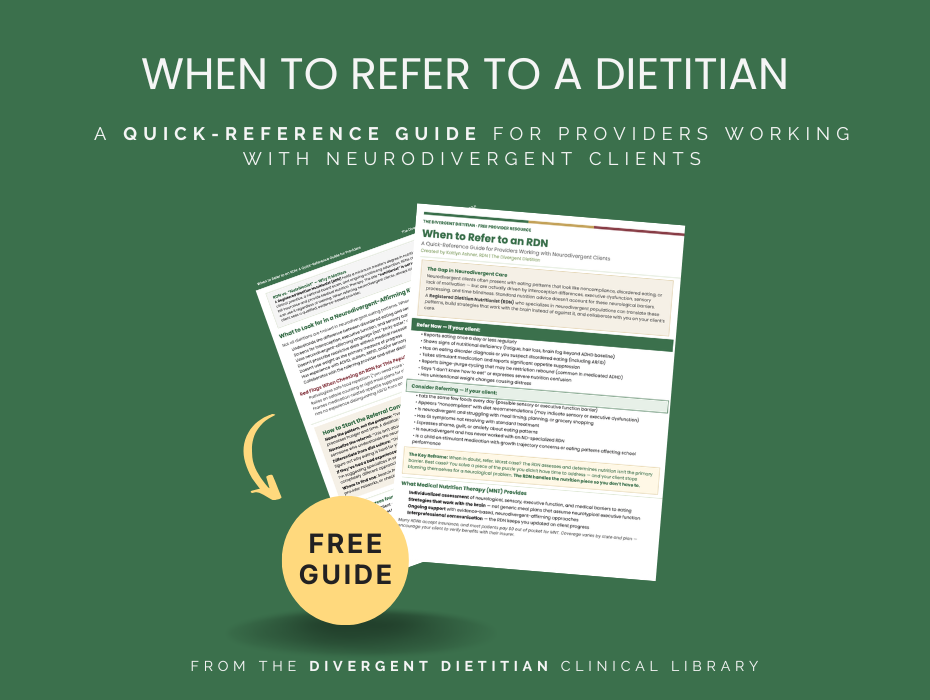
This free 2-page guide gives you a clear referral framework: when to refer to a Registered Dietitian Nutritionist now, when to consider referring, and exactly what to say to the client when you do. It also tells you how to find an RDN who actually understands neurodivergent brains — and how to spot one who doesn’t.
Two pages. Zero cost. Built by an AuDHD clinician who got tired of receiving referrals that said “noncompliant with diet” when the client’s brain was the barrier nobody assessed.
WHAT HAPPENS WHEN A PROVIDER USES THIS TOOL
Your ADHD client mentions they’ve been eating once a day. You’re not sure if it’s depression, restriction, or something neurological — and you don’t have a nutrition background to parse the difference. Flip to the “Refer Now” tier: eating once a day or less is on the list. That’s your answer. Refer.
But maybe the pattern is subtler. Your autistic client eats the same five foods and seems fine with it, but you’re not sure if that’s a problem. Check “Consider Referring”: same-food patterns driven by sensory or executive function barriers. The guide tells you it’s worth a referral — worst case, the RDN assesses and says nutrition isn’t the primary barrier.
Now you need to actually have the conversation. Page 2 gives you five ready-to-use scripts: how to name the pattern without pathologizing it, how to normalize the referral, how to differentiate an ND-affirming dietitian from diet culture, what to say when your client has had a bad experience with a dietitian before, and where to actually find an RDN who specializes in this population.
You also get a quick-reference checklist of green flags and red flags for choosing an ND-affirming RDN — so you’re not just referring, you’re referring well.
WHY I BUILT THIS
I built this because most providers want to refer for nutrition support but don’t know when the threshold is met, what to say, or who to send their client to. The result is one of two things: they don’t refer at all, or they refer to a dietitian who hands their neurodivergent client a meal plan and makes things worse.
This guide closes both gaps. It gives you a clear clinical threshold for when nutrition is part of the picture, language that makes the referral feel like support instead of criticism, and criteria for finding an RDN who won’t undo your therapeutic work by pathologizing your client’s neurological eating patterns.
From the handout: “When in doubt, refer. Worst case? The RDN assesses and determines nutrition isn’t the primary barrier. Best case? You solve a piece of the puzzle you didn’t have time to address — and your client stops blaming themselves for a neurological problem.”
PAGE-BY-PAGE BREAKDOWN (2 PAGES)
Page 1 — The Referral Framework:
- The Gap in Neurodivergent Care — why standard nutrition advice fails this population and what an RDN who specializes in neurodivergence actually does differently
- Refer Now — 7 clinical indicators that warrant immediate RDN referral: eating once daily or less, signs of nutritional deficiency, eating disorder diagnosis including ARFID, stimulant appetite suppression, binge-purge cycling as restriction rebound, severe nutrition confusion, unintentional weight changes
- Consider Referring — 7 indicators for proactive referral: same-food patterns, apparent “noncompliance,” meal planning struggles, unresolved GI symptoms, shame about eating, never worked with an ND-specialized RDN, pediatric stimulant medication with growth or school performance concerns
- The Key Reframe — the clinical logic for defaulting to referral
- What Medical Nutrition Therapy (MNT) Provides — 4 components of ND-affirming MNT including interprofessional communication
- Insurance note — most patients pay $0 out of pocket

Page 2 — Finding the Right RDN + Having the Conversation:
- RDN vs. “Nutritionist” — Why It Matters — the credential distinction most providers don’t know: minimum master’s degree, 1,000+ supervised hours, national board exam vs. an unprotected title anyone can use
- What to Look for in a Neurodivergent-Affirming RDN — 7 green flags including interoception/executive function screening, neurodivergent-affirming language, and interprofessional collaboration with OT, SLP, and mental health
- Red Flags When Choosing an RDN — 4 warning signs: pathologizing safe foods, rigid meal plans for executive dysfunction, framing appetite suppression as weight positive, no ARFID experience
- How to Start the Referral Conversation — 5 scripts: naming the pattern, normalizing the referral, differentiating from diet culture, handling a bad past experience, and where to search for an ND-affirming RDN
- Provider Resources from The Divergent Dietitian — 3 cross-linked products with pricing and WR shop link
WHO THIS IS FOR
- Therapists and counselors who hear about food struggles in session but don’t know when it crosses the line from “something we can address here” to “this needs a nutrition specialist” — this gives you the threshold and the language
- Psychiatrists and prescribers managing stimulant medications who need to know when appetite suppression has become a nutrition problem, not just a medication side effect — and how to talk to the client about adding an RDN to their care team
- Occupational therapists working on sensory processing who want clear criteria for when to loop in a dietitian — and how to find one who understands sensory eating patterns instead of pathologizing them
- Primary care providers and pediatricians who see neurodivergent patients with eating concerns and need a quick-reference tool for the referral conversation — especially for pediatric patients on stimulants with growth trajectory concerns
- School psychologists identifying food-related barriers to learning in neurodivergent students who need to recommend nutrition referrals to parents
HOW THIS RELATES TO OTHER DIVERGENT DIETITIAN PRODUCTS
This is the front door to the entire product line. It answers the first question — “should I refer?” — and the paid products answer everything after that. Translate Your Client ($14.99) is the deep-dive companion: where this guide gives you 7 referral triggers, Translate Your Client gives you 7 neurological translations, 5 barrier explanations, and 6 conversation scripts for the clinical encounter itself.
If providers find this guide useful enough to share (and the copyright line explicitly invites that), they’ll naturally explore Translate Your Client for the full clinical communication toolkit, the ADHD and Autism Provider Education Tool for screening and assessment, or the Neurodivergent Nutrition Starter Kit for the complete 5-handout clinical bundle.
WHAT MAKES THIS ONE DIFFERENT
Most referral guides are either too vague (“refer when appropriate”) or too clinical for real-world use. This one gives you specific observable patterns — not diagnoses you’d need training to identify — mapped to a two-tier decision framework you can use in real time. The referral scripts are written in first person so you can say them verbatim. The green flag / red flag checklist means you’re not just referring — you’re referring to someone who won’t make things worse.
And the RDN vs. “nutritionist” distinction on page 2 is something most providers have never been taught. That single paragraph could save your client from seeing someone with a weekend certification instead of a master’s-level clinician with 1,000+ hours of supervised practice.
This isn’t a clinical education module. It’s a decision tool you keep in your desk, pull out when your neurodivergent client mentions food, and use to make a referral that actually helps.
YOU MAY ALSO LIKE
- Feeding the ADHD Brain: Complete Client Resource Set – $34.99
- Not Laziness: ADHD and Autism Provider Education Tool — $14.99
- Time Blindness & Meal Timing: ADHD & Autism Compensatory Strategies – $9.99
PRICE: FREE
FORMAT: PDF, 2 pages, US Letter, print-ready, instant download, professionally designed with neurodivergent-accessible formatting (Poppins font, high-contrast color coding, structured visual hierarchy). Free for professional use — share with colleagues.
CREATED BY: Kaitlyn Ashner, RDN — neurodivergent-affirming nutrition specialist, AuDHD clinician, and creator of The Divergent Dietitian
You must log in and be a buyer of this download to submit a review.