
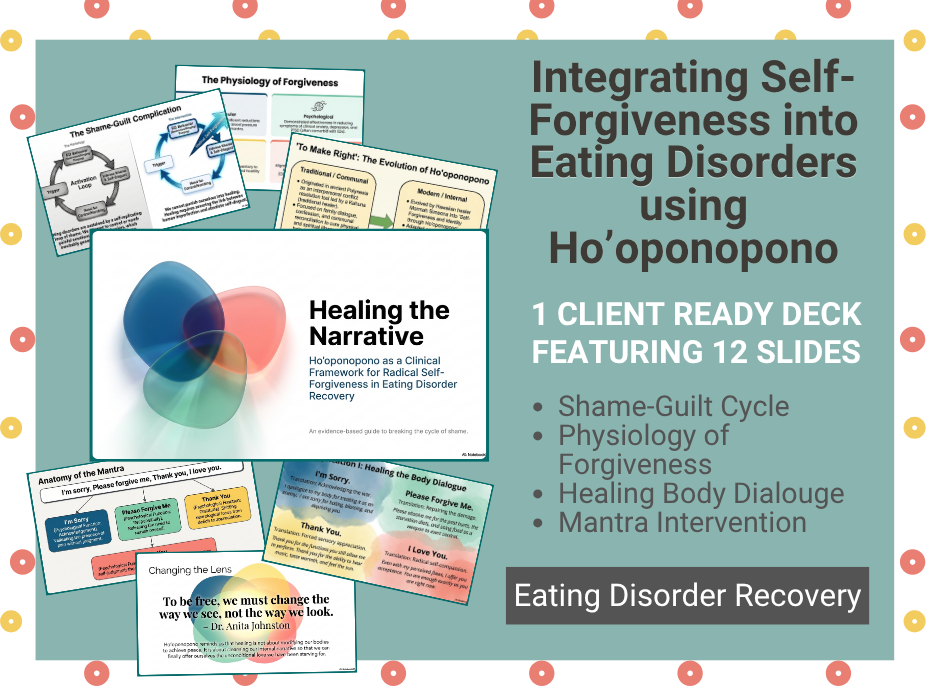
- I’m sorry: Taking responsibility for any negative thoughts, neglect, or harsh judgments you’ve directed at your body.
- Please forgive me: Seeking forgiveness from your body and your subconscious mind for the lack of acceptance.
- Thank you: Expressing deep gratitude for everything your body does for you daily.
- I love you: Reconnecting with your body and affirming love as the ultimate healing force
Supporting clients in breaking free from the self-destructive loops of eating disorders requires deeply compassionate, evidence-based tools that target the psychological roots of care. This 12-slide, professionally designed PowerPoint deck gives clinicians a structured, client-friendly framework to address the profound shame and guilt that sustain eating disorders and build a foundation for radical self-forgiveness. Designed for dietitians, therapists, and medical providers, this resource translates psychological and behavioral research into beautiful, accessible visuals and actionable strategies you can use immediately in session.
What’s Included
- 12 professionally designed slides
- PowerPoint (.pptx) format
- Client-friendly clinical flowcharts and comparative layouts
- Evidence-informed explanations of the shame-guilt activation loop, the physiology of forgiveness, and behavioral interventions
Key Teaching Metaphors These concepts help clients dismantle the psychological mechanisms behind their experiences:
- The Activation Loop — Understanding how eating disorder behaviors are sustained by a self-replicating cycle of shame, control, and absolute self-blame.
- The Clinical Missing Link — Illustrating how lower baseline levels of self-forgiveness fuel psychological addiction and the belief that one is undeserving of love.
- The Evolution of Ho’oponopono — Mapping the paradigm shift from a traditional, communal conflict-resolution tool to a modern, internal practice centered on unconditional self-responsibility.
- Anatomy of the Mantra — Breaking down the specific psychological functions of I’m sorry, Please forgive me, Thank you, and I love you as direct antidotes to self-judgment.
Core Clinical Content This deck breaks down the clinical theory and psychological implications in a digestible, visual format:
- The Shame-Guilt Complication — A clear, side-by-side visualization of eating disorder pathology versus clinical intervention via radical self-forgiveness.
- The Physiology of Forgiveness — A comprehensive breakdown highlighting the cardiovascular, psychological, and emotional benefits of forgiveness interventions, aligning seamlessly with mechanisms of action in CBT and DBT.
- Healing the Body Dialogue — Concrete translations of the four-part mantra specifically tailored to repairing past biological damage and body-directed hatred.
- Soothing the Nervous System — An inner-child mapping model reframing emotional eating and purging as desperate coping mechanisms responding to unmet emotional pain.
- In-the-Moment Trigger Intervention — A step-by-step clinical flowchart tracing a 4-point action plan: Mindful Pause, Identify the Pain, Deploy the Mantra, and Neutralize & Release.
- Dismantling Resistance to Forgiveness — A powerful contrast grid refuting common recovery myths with biological and psychological realities (e.g., perfectionism vs. compassion).
How to Use This in Your Practice
- Individual Sessions — Utilize the “In-the-Moment Trigger Intervention” and “Shame-Guilt Complication” slides to provide immediate, actionable cognitive reframing for clients stuck in active restriction, binging, or purging cycles.
- Group Therapy — Facilitate workshops on “Dismantling Resistance” and the “Body Dialogue” to help group members collectively decouple their moral character from body modifications.
- Behavioral Goal Setting — Walk through the “Soothing the Nervous System” concentric mapping as a collaborative session worksheet to identify baseline triggers and manage nervous system overwhelm.
Who This Is For
- Registered dietitians
- Therapists, counselors, and psychologists
- Multidisciplinary eating disorder treatment teams
- Health professionals practicing from holistic, weight-inclusive, or trauma-informed recovery frameworks
Important Notes
- PowerPoint format only (.pptx)
- No Canva or Google Slides version included
- Does not contain facilitator notes
- For educational and clinical guidance use; not a substitute for individualized, higher-level medical or psychiatric stabilization
About the Seller With over 13 years of experience as a Registered Dietitian, I have specialized in eating disorder recovery across various levels of clinical care for more than six years. I am passionate about exploring the latest psychological and physiological research to ensure every presentation I create is strictly evidence-based, providing you with the high-yield, practical tools needed to navigate complex recovery topics with confidence.
You must log in and be a buyer of this download to submit a review.