
Released in 2004, Morgan Spurlock’s documentary Super Size Me became an instant mainstream juggernaut. Nominated for an Academy Award, the film tapped into a growing public anxiety regarding obesity and corporate fast-food giants. It quickly transitioned from movie theaters directly into the classroom. For nearly two decades, an estimated 70% to 80% of health and biology teachers across the United States regularly screened the film. By utilizing a fast-paced, humorous personal experiment, the documentary served as a primary teaching tool to educate adolescents on the apparent physiological “toxicity” of fast food.
Manufacturing a Food Panic
Super Size Me single-handedly popularized a deeply polarizing, black-and-white narrative surrounding nutrition. By showcasing severe physiological decline—including depression, heart palpitations, and what a doctor on-screen described as a “pickled liver”—the film successfully proliferated a widespread cultural fear of fast food. It taught a generation to view meals as strictly “clean” or “toxic”. This rigid, moralized perspective of food has since been criticized by eating disorder clinicians for fostering unnecessary food anxiety and orthorexic eating patterns.
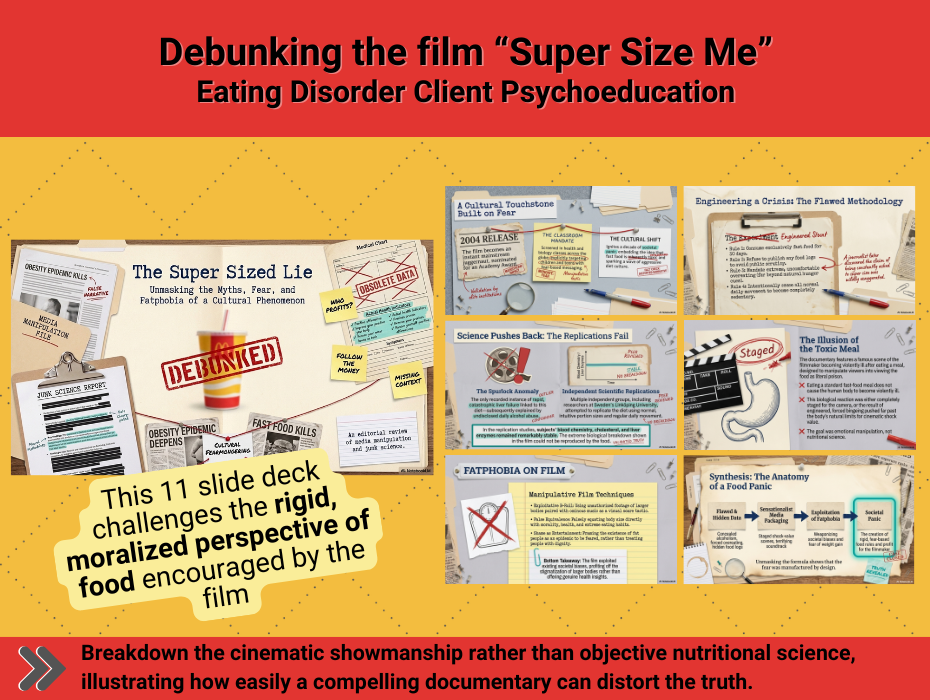
Supporting clients in reclaiming food neutrality and body trust from the legacy of media‑driven fear requires evidence‑based clarity and critical media literacy. This 11‑slide, professionally designed PowerPoint deck gives clinicians a clear, client‑friendly way to dismantle weight‑centric myths, debunk cultural scare tactics, and build an authentic connection to food freedom.
Designed for dietitians, therapists, and medical providers, this resource translates complex media manipulation, independent replication studies, and actual physiological science into accessible visuals and actionable tools you can use immediately in session.
What’s Included
-
11 professionally designed slides structured like an investigative “Media Manipulation File.”
-
PowerPoint (.pptx) format.
-
Client‑friendly visuals, tables, and conceptual flowcharts.
-
Evidence‑informed explanations debunking popular media myths, exploring independent scientific replications, and exposing fatphobia in film.
Key Concepts & Metaphors
These frameworks help clients unpack and unlearn decades of media-driven food and body shame:
-
The Engineered Stunt — Dismantling the highly unrealistic rules and extreme conditions of the 2004 documentary to expose its lack of true scientific basis.
-
The Hidden Variable — Revealing how undisclosed chronic factors, rather than standard fast food, accounted for the filmmaker’s severe biological symptoms.
-
The Illusion of the Toxic Meal — Explaining how physical distress was either staged or the result of extreme, forced overeating to manipulate viewers’ emotions rather than present nutritional science.
-
Black‑and‑White Food Thinking — Unpacking the damaging “Clean vs. Toxic” binary and guiding clients toward a peaceful, weight-inclusive model of Food Neutrality.
Core Clinical & Media Content
This deck breaks down the media manipulation and clinical realities in a highly digestible, visual format:
-
A Cultural Touchstone Built on Fear — An overview of how a single media phenomenon shifted global diet culture and embedded fear-based messaging into school health classes.
-
The Experiment’s Flawed Methodology — A look at the structured, forced overeating rules that intentionally bypassed natural physical hunger and fullness cues.
-
The Hidden Variable — A review of the medical reality behind the filmmaker’s public confession regarding chronic, severe alcohol abuse during the timeline of the shoot.
-
Myth vs. Medical Reality — A side‑by‑side comparative grid mapping the documentary’s claims (rapid liver toxicity, severe mood swings) against actual physiological causes (alcoholic liver disease, alcohol withdrawal).
-
The Replications Fail — A summary of peer‑reviewed independent replication studies (such as research from Sweden’s Linköping University) where participants’ metabolic markers and liver enzymes remained stable.
-
Fatphobia on Film — An analysis of manipulative cinematic techniques used to exploit fatphobia, including unauthorized b-roll of larger bodies and ominous background music.
-
The Anatomy of a Food Panic — A sequential flowchart tracing how hidden data, sensationalist packaging, and cultural biases combine to manufacture societal anxiety and restrictive food rules.
How to Use This in Your Practice
-
Individual Sessions — Use the “Myth vs. Medical Reality” and “The Hidden Variable” slides to provide immediate cognitive reframing for clients struggling with deep-seated fast food anxiety or food guilt.
-
Group Therapy — Facilitate a session on “Media Literacy & Fatphobia” using the “Fatphobia on Film” slide to help clients decouple their moral character from body size and eating habits.
-
De-escalation Work — Utilize the “Anatomy of a Food Panic” flowchart to help clients logically trace and dismantle the manufactured fears keeping them stuck in restriction.
Who This Is For
-
Registered dietitians and nutritionists.
-
Therapists, counselors, and psychologists.
-
Multidisciplinary eating disorder treatment teams.
-
Health professionals practicing from an intuitive eating, weight‑inclusive, or HAES® framework.
Important Notes
-
PowerPoint format only (.pptx). Slides unbranded and text not editable.
-
No Canva or Google Slides version included.
-
Does not contain facilitator notes.
-
For educational use; not a substitute for individualized medical or psychiatric care.
About the Seller
With over 13 years of experience as a Registered Dietitian, I have specialized in eating disorder recovery across various levels of clinical care for more than six years. I am passionate about exploring the latest research to ensure every presentation I create is strictly evidence‑based, providing you with the high‑yield, practical tools needed to navigate complex recovery topics with confidence.
You must log in and be a buyer of this download to submit a review.