
Advocating for clients navigating medical weight bias while protective of their eating disorder recovery requires nuance, authority, and practical behavioral scripts. This 10-slide, professionally designed PowerPoint deck gives clinicians and advocates a clear, client-friendly toolkit to dismantle outdated clinical frameworks, challenge automatic assumptions, and demand weight-inclusive medical care.
Designed for dietitians, therapists, patient advocates, and multidisciplinary eating disorder teams, this resource translates physiological data and systemic bias into highly accessible visuals and interactive tools you can use immediately in sessions or hand directly to clients.
What’s Included
- 10 professionally designed slides
- PowerPoint (.pptx) format
- Client-friendly visuals and scripts
- Evidence-informed physiological data to challenge the necessity of standard medical weight checks.
Key Teaching Metaphors & Tools
These concepts help clients unpack the harm of systemic bias and confidently assert personal agency in clinical spaces:
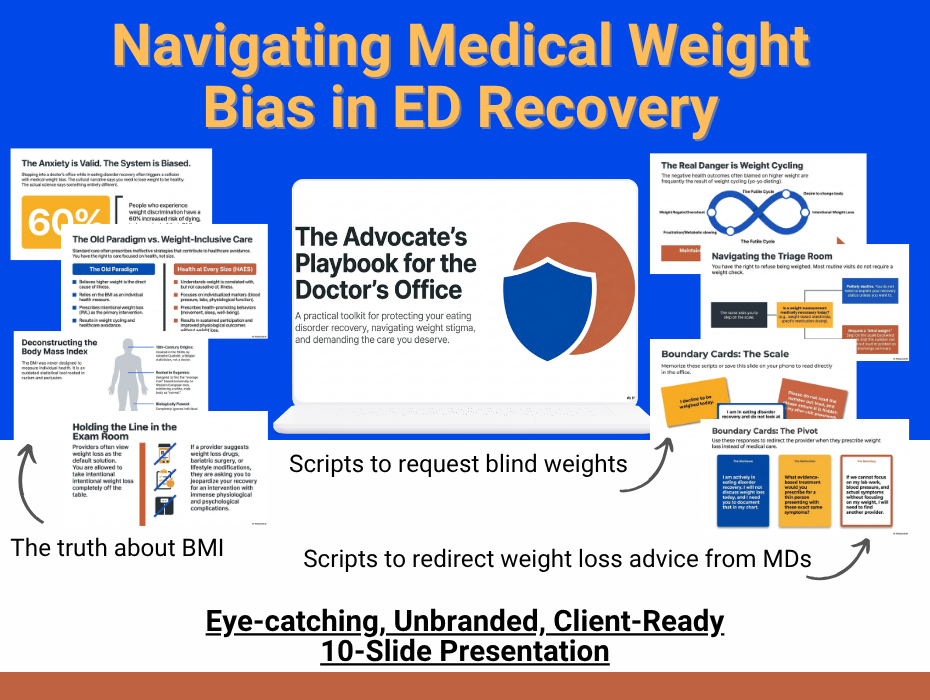
- The Old Paradigm vs. Weight-Inclusive Care — A side-by-side comparison detailing how standard care relies on ineffective interventions while the Health at Every Size (HAES) framework prioritizes individualized, health-promoting behaviors.
- Deconstructing the Body Mass Index — An eye-opening timeline tracing the BMI back to its 19th-century origins, revealing why it is a flawed statistical tool completely unsuited for individual health measurements.
- The Futile Cycle — An intuitive infinity-loop visual tracking the psychological and physiological trap of dieting, metabolic slowing, and inevitable weight overshoot.
- The Triage Decision Tree — A step-by-step roadmap guiding clients through their options the exact moment a nurse asks them to step onto a scale.
- Physical Boundary Cards — Highly practical, downloadable script cards tailored to the scale and the exam room, giving clients exact words to decline a weigh-in or request a “blind weight”.
Core Clinical Content
This deck breaks down the science of weight stigma and the pathology of intentional weight loss in an objective, empowering format:
- The Physiological Impact of Stigma — Unpacking the data showing that weight discrimination increases mortality risk by 60%, independent of an individual’s BMI.
- The Futility Metrics of Intentional Weight Loss — Hard statistics proving the 95% five-year weight regain rate and the 66% weight overshoot rate associated with standard restrictive interventions.
- The Biology of Weight Cycling — Educational breakdowns demonstrating why maintaining a steady higher weight yields vastly superior health and metabolic outcomes compared to yo-yo dieting.
- The Provider Pivot Scripts — Dedicated communication strategies (“The Disclosure,” “The Redirection,” and “The Boundary”) to firmly pivot the focus of an appointment back to objective lab work, symptoms, and actual care.
How to Use This in Your Practice
- Individual Sessions — Walk through the “Old Paradigm vs. HAES” matrix to validate client medical anxiety and collaboratively practice the boundary scripts before upcoming doctor appointments.
- Group Therapy Workshops — Facilitate structured groups on self-advocacy, empowering clients to screenshot the “Boundary Cards” onto their phones to use as direct references in medical offices.
- Discharge & Transition Planning — Provide the triage roadmap as an essential protective blueprint to preserve eating disorder recovery as clients step down to independent medical care.
- Provider Education — Use the BMI and weight-cycling data slides to cross-train local general practitioners, pediatricians, or OBGYNs on providing trauma-informed, weight-inclusive care.
Who This Is For
- Registered dietitians and nutritionists
- Therapists, psychologists, and clinical counselors
- Eating disorder treatment teams and recovery coaches
- Patient advocates and healthcare professionals committed to weight-inclusive medicine
- Important Notes
- Format: PowerPoint format only (.pptx). Slides unbranded, but not editable.
- Exclusions: No Canva or Google Slides templates are included.
- Notes: Built cleanly to speak for itself; does not contain auxiliary facilitator text
- Disclaimer: For psychoeducational use; not a substitute for individualized clinical or psychiatric intervention
About the Seller
With over 13 years of experience as a Registered Dietitian, I have specialized in eating disorder recovery across various levels of clinical care for more than six years. I am passionate about exploring the latest research to ensure every presentation I create is strictly evidence-based, providing you with the high-yield, practical tools needed to navigate complex recovery topics with confidence.
You must log in and be a buyer of this download to submit a review.