
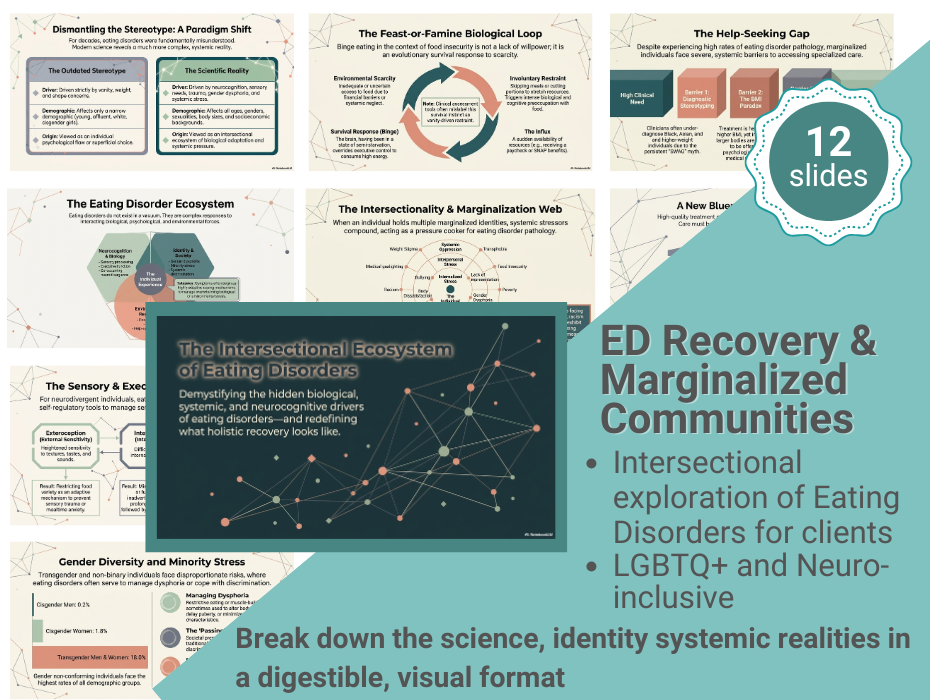
Supporting clients who are holding marginalized or intersecting identities during eating disorder recovery requires nuance, clarity, and an anti-oppressive framework. This 12‑slide, professionally designed PowerPoint deck gives clinicians a clear, client‑friendly way to shift the conversation from individual shame to a biological and systemic survival model.
Designed for dietitians, therapists, and multidisciplinary ED teams, this resource translates complex brain‑based science, neurodiversity-affirming concepts, and social determinants of health into accessible visuals and metaphors you can use immediately in session.
What’s Included
- 12 professionally designed slides
- PowerPoint (.pptx) format
- Client‑friendly metaphors and visuals
- Evidence‑informed explanations of how neurobiology, identity, and environmental environments collide
Key Teaching Metaphors
These metaphors help clients understand the intersectional ecosystem behind their experiences:
- The Adaptive Survival Strategy — Shifting the view of ED symptoms from personal failures to deeply human attempts to survive in an overwhelming world.
- The Mask — Distinguishing between rigid eating disorder behaviors and natural, healthy neurodivergent (Autistic/ADHD) traits.
- The Hunger Loop Battlefield — Understanding how blunted interoception, sensory processing, and an inability to identify feelings (alexithymia) manipulate mealtimes.
- The Feast-or-Famine Loop — Reframing compulsive binge episodes as an evolutionary biological survival response to financial stress or resource scarcity.
- The Life Raft of Body Neutrality — Moving away from toxic societal body positivity toward an affirming focus on functional capability and safety.
Core Clinical Content
This deck breaks down the science, identity intersections, and systemic realities in a digestible, visual format:
- The Paradigm Shift Matrix — A direct comparative lookup contrasting outdated, narrow clinical stereotypes with rigorous scientific realities.
- The Three-Tier Ecosystem — An intersectional framework mapping out how neurocognition, identity, and environment structurally overlap.
- The Sensory Engine — A deep dive into exteroceptive sensitivity and sensory trauma to identify food variety restrictions without added guilt.
- Gender Diversity Risk Chart — Visualizing the striking statistical realities of minority stress, highlighting the staggering 18.0% eating disorder risk faced by transgender individuals.
- The Help-Seeking Gap — A visual breakdown of clinical barriers, detailing how diagnostic stereotyping and weight stigma keep vulnerable patients from accessing care.
- Indigenous Healing Models — Introducing clients to Mino-bimaadiziwin—the pursuit of living the good life, defined by internal balance rather than forced societal conformity.
- The Holistic Recovery Wheel — A 4-quadrant ecosystem layout prompting clients to outline authentic recovery goals across their physical, spiritual, mental, and emotional selves.
How to Use This in Your Practice
- Individual Sessions — Walk through the Feast-or-Famine Loop to dismantle intense food guilt or give neurodivergent clients tangible vocabulary to confidently begin unmasking.
- Group Therapy — Use the Sensory Engine or Gender Diversity slides to facilitate deep, validating group discussions and replace toxic body standards with body neutrality.
- Treatment Planning — Utilize the Holistic Recovery Ecosystem layout as a functional intake session worksheet to build a collaborative, individualized sanctuary for long-term healing.
- Patient & Family Education — Provide clear, standardized talking points to safely navigate weight stigma, medical barriers, and neurodiversity accommodations with families.
Who This Is For
- Registered dietitians and nutritionists
- Therapists, counselors, and psychotherapists
- Eating disorder treatment teams operating across residential, PHP, IOP, and outpatient care levels
- Health professionals looking for weight-inclusive, trauma-informed, and anti-oppressive tools
Important Notes
- PowerPoint format only (.pptx)
- Slides not editable, but are unbranded
- No facilitator notes included
- For educational use; not designed to manage acute electrolyte imbalances or prescribe medical refeeding schedules
About the Seller
With over 13 years of experience as a Registered Dietitian, I have specialized in eating disorder recovery across various levels of clinical care for more than six years. I am passionate about exploring the latest research to ensure every presentation I create is strictly evidence-based, providing you with the high-yield, practical tools needed to navigate complex recovery topics with confidence.
You must log in and be a buyer of this download to submit a review.