
Decoding ARFID: A Clinical Roadmap for Adult Recovery
Product Overview
Because Avoidant/Restrictive Food Intake Disorder (ARFID) was not formally recognized until 2013, many adults struggle with severe sensory differences or food anxieties without having the language to explain their experiences. Often misunderstood as simple “picky eaters,” these individuals are highly motivated to participate in life but find themselves paralyzed by sensory difficulties, anxiety, and profound physical discomfort around food.
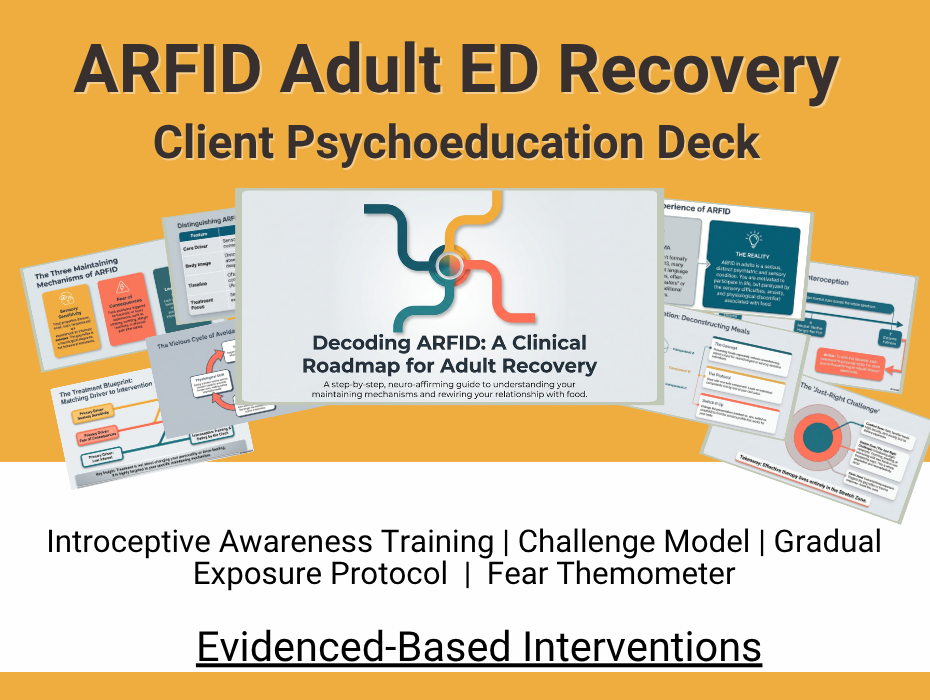
This comprehensive, neuro-affirming presentation provides a step-by-step clinical roadmap designed specifically for adult ARFID recovery. Grounded in the gold-standard Cognitive Behavioral Therapy for ARFID (CBT-AR) framework, this resource details how to target specific maintaining mechanisms, reshape internal body signals, and safely expand an individual’s diet without relying on force-feeding or pressure.
What the Presentation Includes:
- Differential Diagnostic Mapping: A clear diagnostic matrix distinguishing ARFID from Anorexia and Bulimia by isolating core drivers, the complete absence of distorted body image, and chronic timelines heavily correlated with neurodivergence like Autism and ADHD.
- The Three Maintaining Mechanisms: An in-depth breakdown of the distinct physiological profiles underlying ARFID: Sensory Sensitivity, Fear of Aversive Consequences (such as choking or vomiting), and Low Interest/Appetite.
- The Vicious Cycle of Avoidance: A cyclical behavioral model illustrating how negative food triggers lead to safety behaviors, lost reality testing, and a physical shrinking of stomach capacity that makes eating progressively harder.
- Targeted Treatment Blueprints: Direct flowcharts matching specific sensory or anxiety drivers to evidence-based interventions, replacing personality changes with targeted behavioral adjustments.
- Interoceptive Awareness Training: Tools to correct a shifted baseline of hunger and fullness, illustrating how chronically food-restricted individuals learn to ignore standard internal cues.
- Deconstructed Meal Frameworks: Practical methods for sensory modification, showcasing how separating mixed foods into individual, layered components reduces overwhelming sensory input.
- The Just-Right Challenge Model: A neuroplasticity-focused target chart outlining how to stay out of the “Panic Zone” and keep therapeutic work entirely within the productive “Stretch Zone”.
- The Gradual Exposure Protocol: A step-by-step exposure hierarchy tracking progress from simple visual exploration up to chewing and swallowing.
- The Fear Thermometer: A numbered, color-coded anxiety scale ($0\text{–}100$) providing a standardized language to quantify distress and construct an effective exposure hierarchy.
- In-Session Interoceptive Exercises: Step-by-step instructions for physical exercises (like belly expansion, water gulping, and chair spinning) designed to decouple normal bodily sensations from past eating trauma.
- The 4 Stages of CBT-AR: A full breakdown of the standard 20-to-30-session protocol timeline, spanning from initial psychoeducation to long-term relapse prevention.
What it Does NOT Include:
- Weight Restoration Metrics for Anorexia: This deck is built specifically for ARFID. It does not contain body image repair workflows or caloric tracking metrics aimed at addressing an intense drive for thinness or fear of weight gain.
- Pediatric ARFID Strategies: While ARFID is frequently discussed in children, the language, framing, and clinical interventions in this slide deck are tailored exclusively for the lived experience of adults.
Target Audience & Eligible Clinicians
This resource is built to serve as both an advanced clinical guide and an active psychoeducational presentation for:
- Clients & Patients in Treatment: Adults navigating ARFID who need clear, validating science to understand that their gag reflex is a genuine neurological response rather than a personal failure or stubbornness.
- Eating Disorder Therapists & Psychologists (LCSW, LMFT, PsyD): Clinicians looking for a structured, step-by-step presentation format to guide clients through exposure hierarchies and interoceptive retraining.
- Registered Dietitians (RD/RDN): Nutrition professionals looking to implement food chaining, deconstruct meal profiles, and establish tailored eating-by-the-clock schedules.
Application Across Levels of Care
- Outpatient Practices: Provides the exact framework needed to structure a standard, weekly 20-to-30-session CBT-AR treatment plan while utilizing active exposure logs to track at-home practice.
- Intensive Outpatient (IOP) & Partial Hospitalization (PHP): Serves as an excellent group psychoeducation curriculum to help clients self-monitor their thoughts and systematically habituate to novel foods using the “one month per food” golden rule.
- Residential & Inpatient Treatment: Equips multidisciplinary teams with neuro-affirming tools to accommodate sensory needs without force-feeding, helping to safely scale individuals up from their existing comfort zones.
What You Get If You Buy This
When you purchase this digital resource, you receive a client-ready, professional presentation deck built to map out clear behavioral strategies for sensory and avoidant eating difficulties.
File Deliverables & Specifications
- File Type: Delivered as an unbranded, high-resolution PowerPoint presentation (.pptx) file.
- Client-Ready: Fully finalized, polished, and styled with high-contrast visuals—ready for direct delivery in individual therapy, group psychoeducation, or professional clinical workshops.
- Format Security: Slide layouts, diagnostic tables, and custom graphics are non-editable to preserve precise clinical definitions, behavioral protocols, and CBT-AR timeline citations.
Included Presentation Slides & Visual Assets
- The Picky Eating vs. Reality Contrast Dashboard: A high-contrast visual re-framing adult ARFID from a social stigma to a recognized psychiatric and sensory condition.
- The ARFID vs. Eating Disorder Matrix: A foundational reference table detailing the core differences in drivers, timelines, and treatment focuses between ARFID, Anorexia, and Bulimia.
- The Three Drivers Framework: A bold, three-panel graphic dividing symptoms into Sensory Sensitivity, Fear of Consequences, and Low Interest.
- The Vicious Cycle Loop: A cyclical infographic tracking how safety behaviors and lost reality testing cause a physical shift that limits stomach capacity.
- The Targeted Treatment Blueprint: A matching map that pairs specific primary drivers directly with their corresponding clinical solutions.
- The Shifted Interoception Spectrum: A numbered scale (1-7) illustrating how chronic food restriction alters baseline perceptions of biological hunger.
- The Deconstructed Meal Diagram: An exploded linear graphic using a physical sandwich metaphor to demonstrate the concept of sensory modification and component layering.
- The Stretch Zone Target: A multi-layered concentric circle graphic separating the Comfort, Stretch, and Panic zones to show where adaptation occurs.
- The Gradual Exposure Staircase: A 4-step progressive timeline mapping the journey from physical interaction to complete dietary integration.
- The Fear Thermometer Graphic: A high-contrast vertical thermometer scaling anxiety from complete calm (0-20) to total panic (90-100).
- The Interoceptive Signal Dashboard: An icon-based guide outlining specific in-session somatic exercises like belly distension, rapid swallowing, and dizziness simulation.
- The CBT-AR Stage Timeline: A step-by-step linear roadmap laying out the 4 stages of treatment across a standard 20-to-30-session protocol.
- The Exposure Log Template: A practical progress tracker dividing food interactions into Sensory Profile ratings (1-10) and objective reality-testing thought records.
- The World Expansion Summary: A final 3-part takeaway panel reinforcing that ARFID is a real, biologically based condition responsive to customized, neuro-affirming support.
You must log in and be a buyer of this download to submit a review.