
Stop Asking Your Client to “Just Stop Bingeing.”
Help Them Understand What’s Driving It.
“I don’t understand why I keep doing this.”
“I wasn’t even hungry.”
“Once I start eating, I can’t stop.”
“I did really well all day…and then I blew it.”
“I just need more self-control.”
When a client is struggling with binge eating, the binge itself tends to get all the attention.
How often did it happen?
What did they eat?
How do we make sure it doesn’t happen again?
But if we only focus on stopping the behavior, we can miss the much more useful question:
What’s making binge eating feel necessary in the first place?
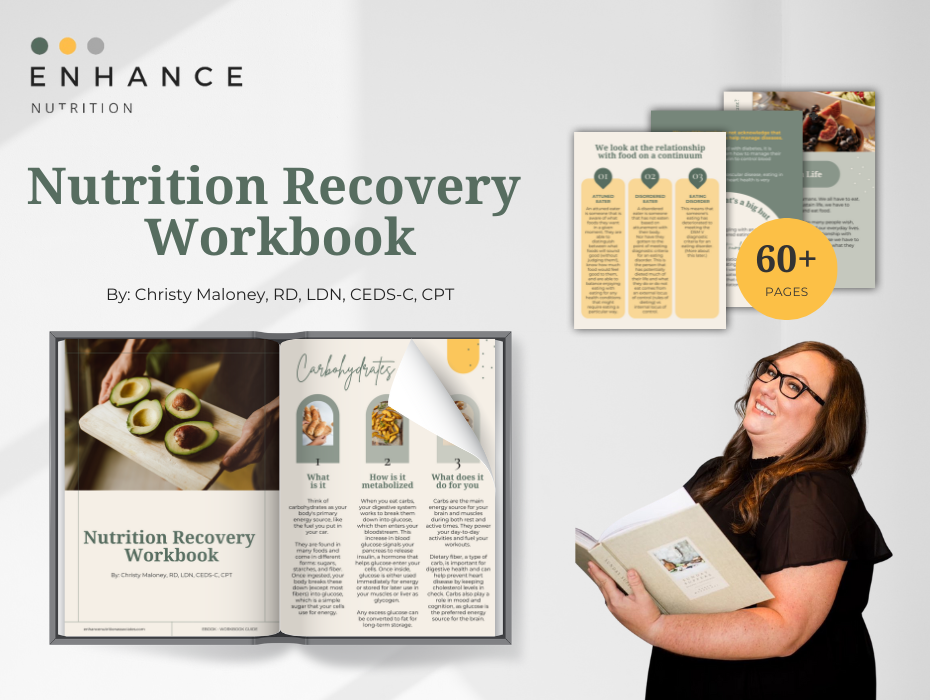
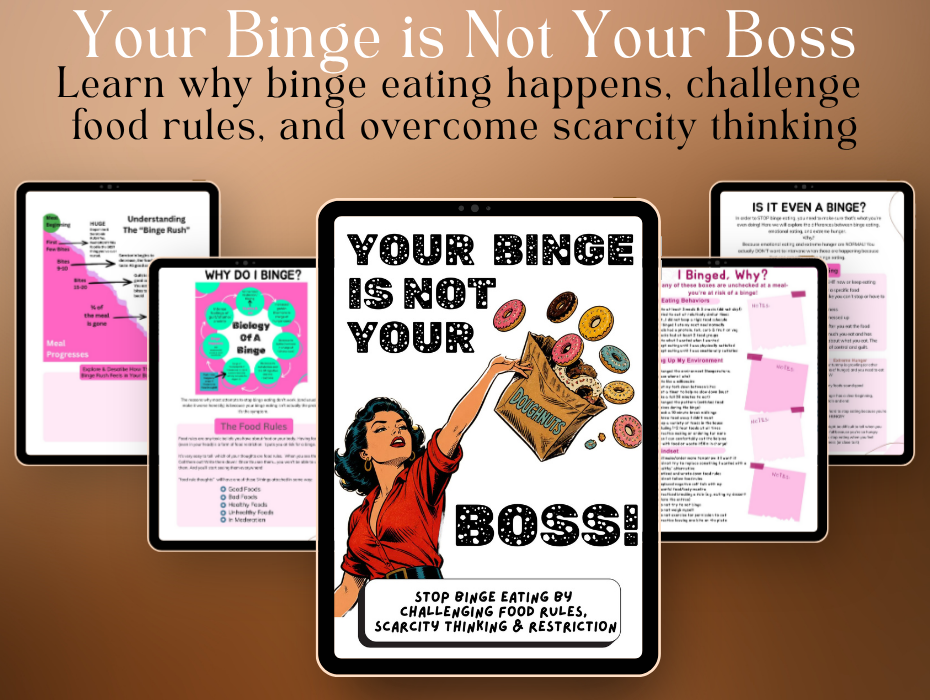
That’s what this workbook is designed to help you explore.
Turn “I Binged Again” Into a Clinical Conversation.
Binge eating can be influenced by physical restriction, mental restriction, food scarcity, deprivation, rigid food rules, emotional coping, habituated patterns, and other individual factors.
And sometimes what a client calls a “binge” isn’t actually a binge at all.
They may be experiencing extreme hunger after inadequate intake.
Eating an amount that feels unacceptable because of rigid food beliefs.
Responding normally to prolonged restriction.
Eating emotionally and labeling the experience a binge because they weren’t physically hungry.
Or experiencing recurrent episodes that warrant further assessment for an eating disorder.
Those distinctions matter.
This workbook gives dietitians a structured way to start teasing them apart.
A Practical Tool for Binge-Eating Nutrition Work
Use the workbook during sessions, select individual exercises for between-session work, or return to different sections as patterns emerge.
It can help you explore:
Physical restriction
Is your client consistently eating enough throughout the day—or is the evening “loss of control” happening after hours of inadequate intake?
Mental restriction
Which foods are technically allowed but still considered “bad,” “unhealthy,” “off limits,” or only acceptable in certain quantities?
The binge-restrict cycle
What happens after a binge? Skipping breakfast? Exercising? “Eating clean”? Cutting portions? Starting over Monday? Explore how compensation may help perpetuate the cycle.
Scarcity and food access
Does your client trust that desired foods will still be available tomorrow, or does eating them feel like a now-or-never opportunity?
Food rules
What seemingly harmless nutrition beliefs are creating deprivation, urgency, or all-or-nothing eating?
Emotional eating
What role is food playing beyond physical hunger—and does that automatically mean something has gone wrong?
Fullness and permission
Can your client stop eating knowing they can have more later, or does leaving food behind trigger anxiety, guilt, or scarcity?
Shame
Can you shift the conversation from “What’s wrong with me?” to “What can we learn from what happened?”
Help Clients Investigate the Binge Instead of Punishing It.
A binge can provide an incredible amount of information.
Instead of immediately creating another plan for preventing the next one, this workbook helps you slow the process down.
You can explore questions like:
What had your client eaten earlier that day?
When was the last time they ate?
Had they been restricting physically or mentally?
Were certain foods “off limits”?
What happened immediately before the episode?
What were they feeling?
What did they believe about the foods they ate?
What happened afterward?
Did they compensate—and could that compensation be setting up the next episode?
Now the binge isn’t simply something to eliminate.
It’s information you can use in treatment.
Because “Binge” Doesn’t Always Mean the Same Thing.
This can be one of the most valuable conversations you have with a client.
Someone may describe eating three cookies as a binge because they intended to eat one.
Another person may eat significantly more food following prolonged restriction because their body is responding to an energy deficit.
Someone else may describe eating for comfort without experiencing loss of control.
And another client may be experiencing recurrent objective binge episodes consistent with an eating disorder that requires appropriate assessment and treatment.
The word binge alone doesn’t tell us enough.
This workbook helps create space to explore what your client is actually experiencing instead of automatically accepting the eating disorder’s definition of “too much.”
What’s Inside
You’ll get a collection of client-friendly education, reflection prompts, and practical exercises designed to help you explore:
- The difference between binge eating, emotional eating, and extreme hunger
- Physical versus mental restriction
- The binge-restrict cycle
- Food rules that may increase binge urges
- Scarcity and perceived deprivation
- Permission and access to previously restricted foods
- Guilt around food waste and stopping at fullness
- Why intense efforts to control eating can sometimes intensify preoccupation and urgency
- Patterns surrounding binge episodes
- Environmental factors that may support recovery
- Guided reflection and journal prompts you can use between sessions
Use the Whole Workbook—or Pull Out What You Need.
This doesn’t have to become another assignment your client needs to “complete.”
Use one worksheet during a session.
Assign a reflection exercise.
Choose a section that corresponds with the pattern you’re currently seeing.
Use a prompt to investigate what happened before a binge.
Return to an exercise later in recovery and compare what’s changed.
The workbook gives you structure without requiring every client to follow the exact same path.
This Isn’t a Weight-Loss Tool.
There are no:
❌ Calorie targets
❌ Weight-loss strategies
❌ “Cheat days”
❌ Plans for compensating after a binge
❌ Lists of foods clients need to eliminate
❌ Lectures about self-control
And it isn’t designed to replace individualized assessment or treatment.
It’s a nutrition counseling resource you can incorporate into your existing work with clients experiencing binge eating, disordered eating, restrictive eating patterns, and complicated relationships with food.
Give Yourself Somewhere to Go After “I Binged Again.”
Instead of responding with another strategy for controlling food, get curious about why the binge happened.
What preceded it?
What maintained it?
What happened afterward?
And what does that tell you about where treatment needs to go next?
Your Binge Is Not Your Boss gives dietitians a structured, client-friendly way to explore those questions without turning recovery into another diet.
Bring it into your next session and start turning binge episodes from something your client feels ashamed of into information you can actually use.
You must log in and be a buyer of this download to submit a review.