
When Your Client Knows “It’s Just Food”…
But Still Can’t Eat It.
“I know a cookie won’t hurt me, but I still can’t do it.”
“I want to challenge it. I just panic when it’s actually in front of me.”
Fear foods can be frustrating because clients often already know the nutrition facts.
More education isn’t necessarily what they need.
They need a structured way to challenge the fear.
This resource gives dietitians a practical framework for identifying fear foods, exploring the beliefs behind them, and creating intentional food challenges with clients.
Turn Fear Foods Into Something You Can Work With
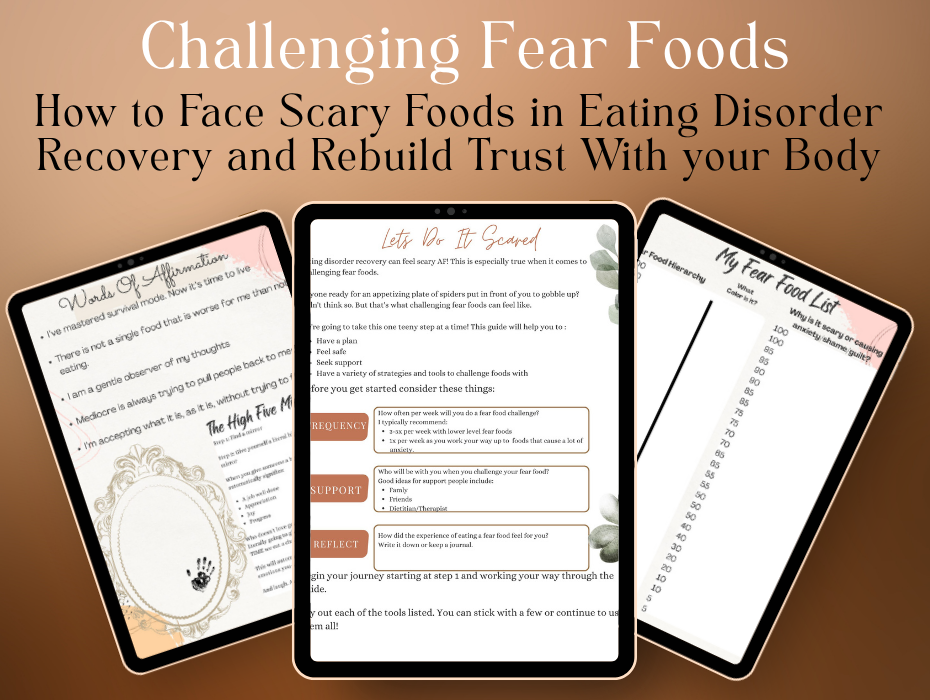
Instead of randomly picking a scary food and hoping for the best, use the workbook to help clients:
- Identify foods associated with anxiety, guilt, avoidance, or compensatory urges
- Build a personalized fear-food hierarchy
- Explore why particular foods feel threatening
- Choose challenges based on the client’s current readiness
- Prepare for exposures before they happen
- Reflect on what actually happened versus what the eating disorder predicted
- Repeat challenges and track how the experience changes over time
Multiple Tools for Different Fear Foods
Not every challenge needs to look the same.
The workbook includes strategies such as:
Visualization — Walk through an upcoming challenge before it happens.
Food Chaining — Create gradual steps between familiar and more challenging foods.
Exposure — Build repeated experiences with feared foods rather than relying on one giant challenge.
Facts vs. Feels — Explore what the eating disorder predicts versus what the client actually knows.
Fear Food Lottery — Introduce repetition and flexibility while reducing some of the negotiation around choosing challenges.
Plus additional reflection exercises and tools you can incorporate into nutrition sessions.
Use It In Session—or Between Them.
- Build a fear-food hierarchy together.
- Choose the next exposure.
- Use an exercise to prepare for it.
- Assign a challenge between sessions when appropriate.
- Then bring the workbook back out and ask:
- What did you predict would happen?
- What actually happened?
- What thoughts showed up?
- Did you notice urges to restrict or compensate afterward?
- What would make the next exposure more supportive?
Now you’re not just telling your client to challenge fear foods. You have a framework for actually doing it.
What’s Included
- Fear-food identification exercises
- 1–100 fear hierarchy
- Food-category prompts and examples
- Multiple fear-food challenge strategies
- Thought-challenging exercises
- Exposure preparation and reflection prompts
- Tools for tracking progress over time
- A repeatable framework you can use throughout treatment
Give Fear-Food Work Some Structure.
Your client doesn’t need another lecture about why carbohydrates are okay.
They may need opportunities to experience eating the carbohydrate and discover that they can tolerate everything that comes with it.
This resource gives dietitians a practical, client-friendly framework for turning fear foods from an abstract recovery goal into something you can actually work on together.
Bring it into your next nutrition session and start turning “I know it’s just food, but…” into a plan for what comes next.
Please Note:
**A Note About Language:** This workbook takes a candid, sometimes humorous approach to challenging fear foods and includes occasional profanity and informal expressions throughout. Please consider whether this tone is appropriate for your practice and the clients you serve before purchasing.
You must log in and be a buyer of this download to submit a review.