

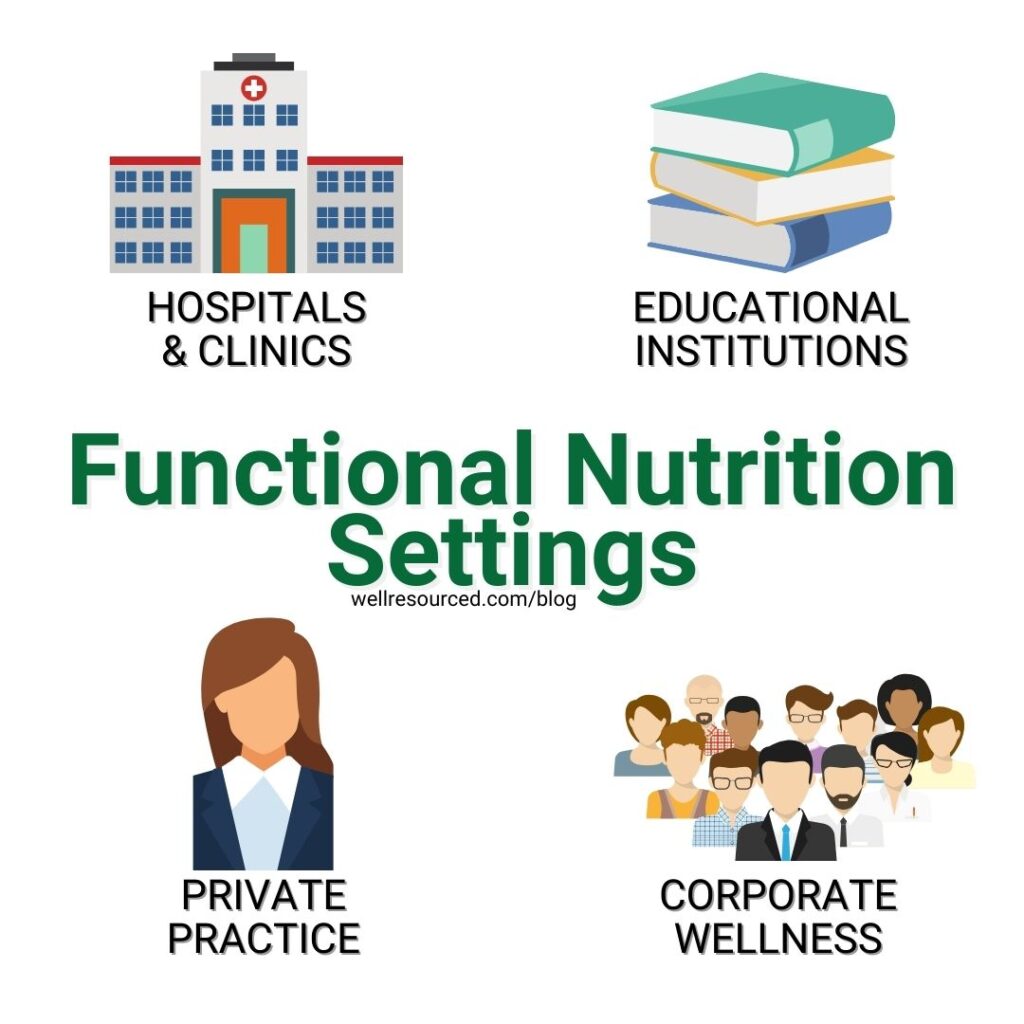
Functional nutritionists are masters in unraveling the complex root causes behind symptoms and disease. They examine lifestyle, nutrition, and biological factors to address a patient’s health in a holistic way. They can work in outpatient care settings, corporate wellness, private practice, and more.
Does this sound like your dream job? If so, you’ll want to brush up on educational pathways for how to become a functional nutritionist so you can start making an impact!
It can be a little confusing, because there’s no one required route for this career path. Let’s break down what you need to know to start working in this field
Requirements to be a functional nutritionist
There is no one required educational pathway. In fact, the term “functional nutritionist” does not have a specific legal definition in the United States. Theoretically, anyone could call themselves a functional nutritionist (which can be problematic if that person doesn’t have an actual background in the field!).
However, different states have licensure rules regarding performing medical nutrition therapy, which may or may not be part of your functional nutrition practice. Some states might require you to be a Registered Dietitian (RD) in order to be licensed in the state to perform medical nutrition therapy. If that is part of your practice goals, then you would need to obtain your RD credential in order to do so in the state. Other states have no requirements for licensure.
It is wise to consider what your goals are as a functional nutritionist, how you plan to practice, and what state you live or practice in when considering the best educational pathway.
That said, all competent functional nutritionists should have a strong educational background that includes topics like biology, nutrition, and chronic health conditions, and should get advanced training in functional medicine.
Educational pathways and certifications
Many of you reading this are already Registered Dietitians, and that gives you a great background prior to going through specialty certifications.
If you are not a dietitian (and not planning to become one), a bachelor’s degree in Nutrition or a pre-med pathway is a smart starting point for work as a functional nutritionist. These types of programs will help you understand the basics of biology, metabolism, and nutrient functions.
Once you’ve built your educational foundation, you can enroll in a structured certification program to enhance your skill set specific to functional medicine and nutrition. Some popular programs include:
- DIFM Practice Group Certificate of Training Program (currently unavailable but set to return later in 2025)
We’ve put together a detailed guide on all of these functional nutrition certification programs. Definitely review it to see which is the best fit for your goals.
How long does it take and how much does it cost?
Training length and cost will both depend on your educational background and which certification or continuing education programs you choose. A program may be as short as a few months or could last several years. The cost of a short continuing education program might be a few hundred dollars while a Masters degree program could be upwards of $30,000.
Do you have to be a dietitian to become a functional nutritionist?
This is one of the most common questions that arise when considering this career. You generally do not have to be a dietitian to become a functional nutritionist. However, note that a) some certification programs may require that as a prerequisite for their individual program, and b) your state may require you to be a dietitian if you are performing medical nutrition therapy.
What is the difference between a functional nutritionist and a dietitian?
Functional medicine, including functional nutrition, is a different approach to patient care than how many dietitians have been traditionally trained – but does have some overlap.

In traditional dietitian training programs, the education is centered around disease diagnosis and the management of those diseases. For example, a dietitian may use the DASH diet to manage hypertension or the low-FODMAP diet to curb symptoms of IBS. In general, there are standard protocols of care, and treatment is focused on symptom management.
In contrast, with functional nutrition, the approach is more about cultivating health than disease management. The approach tends to see the body as an interconnected whole, with all systems interacting and influencing one another. In the functional-nutrition paradigm, an imbalance in one body system will have an impact on the rest of the body.
Functional nutrition is also about getting down to the root cause of issues. A functional nutrition dietitian doesn’t just acknowledge a diagnosis of IBS, they will ask “why” and work to identify the root cause. And then, create a personalized treatment protocol to fix it.
The two approaches – traditional and functional nutrition – are on a spectrum. It is absolutely possible for nutrition professionals to be somewhere in between, incorporating both approaches into their nutrition care. Both dietitians and non-RD nutrition professionals can use functional nutrition resources in their practice.
The goal is always to optimize the patient’s outcome. Both approaches are geared towards improving the health and wellness of their clients, they’re simply approaching the issue from different angles.

The Bottom Line
There are many different routes towards becoming a functional nutritionist, but all generally start with some type of educational background in the nutrition or medical field. From there, you can pursue specialty certifications for enhanced knowledge specific to functional medicine. Let your career and practice goals guide you towards the right pathway!
Recommended reading
Ready to learn more? We’ve hand-picked a few favorites from the blog.
- 30+ Functional Nutrition Resources to Use with Clients – Looking for functional nutrition resources to use with your clients? Find handouts, presentations, and treatment protocols!
- 7 Best Functional Nutrition Certifications – Read up on functional nutrition certifications to boost your career including the IFN certification, University of Western States program, COT in IFMNT…
- The Best Nutrition Coaching Apps for Dietitians & Trainers – Find out which nutrition coaching software programs will help you to streamline your nutrition business and save time.


One comment
Nice review, but another one worth mentioning is Erin Holt’s functional nutrition training. I have not taken her course but it looks good.