
-
Help Clients Stop Counting Calories—Without Just Telling Them to Stop
A ready-to-use session tool for helping clients identify calorie-counting behaviors, challenge mental math, and practice making food decisions without numbers running the show.
You know the conversation.
“Are you still counting calories?”
“No.”
And technically, they’re not.
They deleted the app. They stopped logging meals. Maybe they even stopped looking at nutrition labels.
But they’re still choosing the smaller option just in case.
Eating less at dinner because lunch was “probably a lot.”
Using less dressing.
Avoiding seconds.
Or automatically recalling calorie numbers they’ve had memorized for years.
Stopping calorie counting isn’t always as simple as stopping the math.
Give the Conversation Somewhere to Go
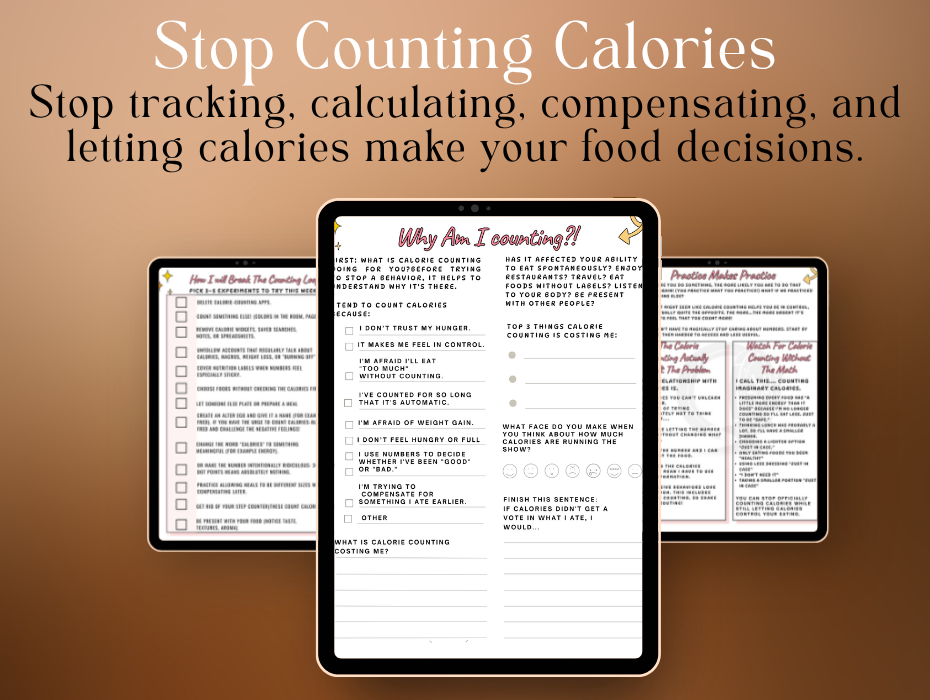
How to Stop Counting Calories is a printable 4-page client workbook designed to help clinicians move beyond “try not to count” and turn calorie-counting work into something concrete you can explore together.
Use it during sessions, assign individual pages between appointments, or work through the exercises alongside your client.
Use It to Help Clients:
-
Identify why calorie counting feels necessary
-
Explore what counting is costing them
-
Recognize automatic and compulsive counting patterns
-
Choose realistic experiments for interrupting the counting loop
-
Reduce access to calorie information
-
Practice eating without checking numbers first
-
Separate knowing a calorie number from acting on it
-
Identify compensation disguised as “not counting”
-
Catch calorie counting without the math
-
Practice allowing different meal sizes without compensating
-
Build evidence of progress without creating another rigid streak
Especially Helpful for the Client Who Says:
“But I already know the calories.”
They might.
Years of calorie counting can leave clients with an enormous mental database of numbers.
Trying to force those numbers out of their head isn’t necessarily the useful target.
Instead, this workbook introduces a different skill:
I can know the number and still eat the food.
Knowing the calories doesn’t mean I have to use that information.
That distinction gives you something much more useful to work with in session than trying to make calorie thoughts disappear.
Catch the Counting That Doesn’t Look Like Counting
One entire section focuses on what I call “imaginary calories.”
Your client may no longer officially track calories while still allowing estimated calories to determine how much, when, or what they eat.
The workbook helps uncover behaviors like choosing a lighter option “just in case,” eating a smaller dinner after a larger lunch, or using less dressing because the actual calorie amount is unknown.
These behaviors can easily fly under the radar when the only question we’re asking is:
“Are you counting calories?”
Turn Insight Into Practice
Clients choose 3–5 experiments to practice, such as removing tracking apps, covering nutrition labels, allowing someone else to prepare or plate food, choosing food without checking calories first, and allowing meals to vary in size without compensating later.
The final worksheet shifts tracking away from calories and toward the behaviors you’re actually trying to strengthen.
And importantly:
It isn’t a streak.
A client can check a calorie label or get pulled into mental math without deciding they’ve “ruined” their progress and need to start over.
What’s Included
4-page printable PDF client workbook
Designed for use in individual sessions, nutrition counseling, therapy, or as between-session practice.
Created by a registered dietitian specializing in eating disorders and disordered eating.
Less “just stop counting.” More actually practicing how.
-
You must log in and be a buyer of this download to submit a review.