
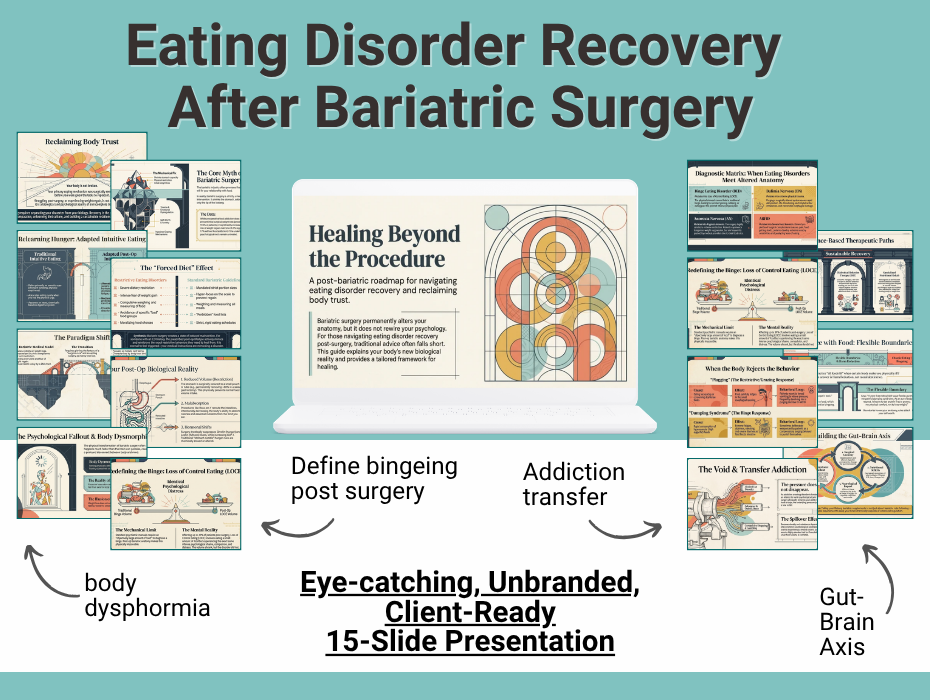
Supporting clients with a surgically altered GI tract during eating disorder recovery requires a specialized, weight-inclusive framework that acknowledges both anatomical changes and underlying psychology. This 15-slide, professionally designed PowerPoint deck provides clinicians with a science-backed roadmap to help clients move past the “forced diet” of bariatric surgery and rebuild a safe relationship with food.
Designed for dietitians, therapists, and multidisciplinary ED teams, this resource translates complex post-surgical biology into accessible visuals and metaphors you can use immediately in session.
What’s Included
- 15 professionally designed slides
- PowerPoint (.pptx) format
- Facilitator script
- Client-friendly metaphors and visuals
- Evidence-informed explanations of post-op hunger, diagnostic shifts, and transfer addiction risks
Key Teaching Metaphors
These metaphors help clients understand the biological shifts following weight-loss surgery:
- The Forced Diet — How traditional bariatric “rules” (tracking, weighing, and small portions) can inadvertently trigger or worsen ED pathology.
- The Diagnostic Mutation — Understanding how behaviors shift post-surgery, such as Binge Eating Disorder turning into compulsive “grazing” due to physical volume limits.
- The Spillover Effect — A neurobiological look at how calorie malabsorption and restriction increase the risk for transfer addictions.
- The Biological Feedback Loop — Reframing post-op grazing or weight regain as natural physical responses rather than personal failures.
- The Interoceptive Shift — A new framework for identifying hunger when traditional cues, like stomach growling, are no longer present.
Core Clinical Content
This deck breaks down the intersection of bariatric surgery and ED recovery in a digestible, visual format:
- The Altered Diagnostic Matrix — A visual guide to how AN, BN, BED, and ARFID present differently after a surgically altered GI tract.
- Hormones & Hunger — Mapping the significant shifts in Ghrelin, Leptin, and GLP-1 following surgery.
- Plugging & Dumping Syndrome — Differentiating between medical complications and eating disorder behaviors to reduce physical fear.
- Adapted Intuitive Eating — A specialized framework for rebuilding body trust and interoceptive awareness when anatomy has changed.
- HAES vs. The Bariatric Model — A comparison guide to help clients move toward a weight-inclusive, values-aligned recovery.
How to Use This in Your Practice
- Individual Sessions: Use the “Altered Diagnostic Matrix” to help a client understand why their symptoms have shifted or to explain the “Spillover Effect” and transfer addiction risks.
- Group Therapy: Facilitate workshops for post-bariatric clients to help them transition from rigid “tracking” to a “mechanical eating” or an adapted intuitive eating approach.
- Multidisciplinary Training: Use this deck as a template to educate doctors, therapists, and surgical teams on the unique psychological needs of this population.
Who This Is For
- Registered dietitians
- Therapists and counselors
- Eating disorder treatment teams
- Bariatric care coordinators
Important Notes
- PowerPoint format only (.pptx)
- Non-editable
- No Canva or Google Slides version included
- Unbranded
- Contains facilitator notes
- For educational use; not a substitute for individualized medical or psychiatric care
About the Seller
With over 13 years of experience as a Registered Dietitian, I have specialized in eating disorder recovery across various levels of clinical care for more than six years. I am passionate about exploring the latest research to ensure every presentation I create is strictly evidence-based, providing you with the high-yield, practical tools needed to navigate complex recovery topics with confidence.
You must log in and be a buyer of this download to submit a review.